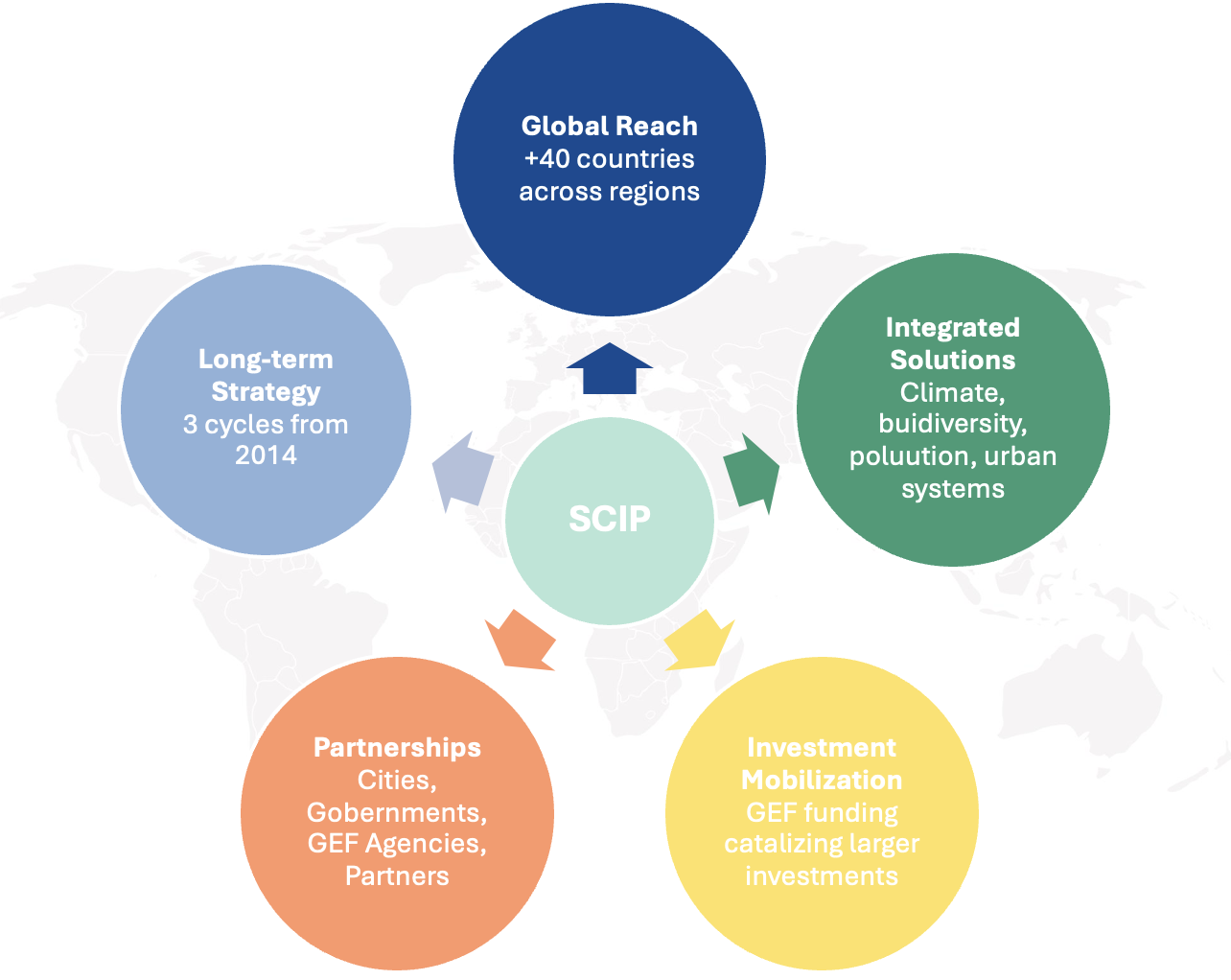



The Sustainable Cities Integrated Program (SCIP) is a flagship initiative of the Global Environment Facility (GEF) that supports cities in developing integrated solutions to address climate change, biodiversity loss, and pollution. Through national and city-level projects, the program helps cities strengthen urban planning, prepare sustainable infrastructure investments, and implement policies that promote low-carbon, nature-positive, and resilient urban development. SCP combines global knowledge with on-the-ground implementation, enabling cities to translate sustainability strategies into concrete actions and investments.
SCIP helps cities advance integrated urban solutions across multiple sectors that deliver both environmental and development benefits. Key areas of support include climate mitigation and low-carbon urban development, nature-based solutions and urban biodiversity, sustainable land use and spatial planning, circular economy approaches for waste and resource management, and resilient infrastructure and urban services.
The Sustainable Cities Integrated Program operates through a combination of national and city-level projects and a global knowledge platform that supports learning and collaboration. City and country projects—implemented by GEF agencies—work with local and national governments to strengthen urban planning, develop investment pipelines, and implement sustainable urban solutions tailored to local priorities.
At the same time, the GPSC connects participating cities with knowledge, technical tools, and peer-learning opportunities that help scale solutions and accelerate impact across the program. Together, these components link global expertise with local action, enabling cities to move from planning to implementation.
The Sustainable Cities program was launched in 2014 under the sixth replenishment of the Global Environment Facility (GEF-6). Since then, it has evolved across successive GEF cycles, expanding its geographic reach, strengthening its thematic focus, and increasing support to cities moving from planning toward implementation and investment.
The first phase of the program introduced the integrated approach to sustainable urban development within the GEF. It supported 28 cities across 11 countries, combining city-level projects with a global knowledge platform to strengthen urban planning and environmental management.
During this phase, the World Bank was selected as the lead agency for the global coordination component, receiving support to establish the Global Platform for Sustainable Cities (GPSC) in 2016. The platform was created to facilitate knowledge sharing, peer learning, and collaboration among cities and partners, while supporting the implementation of US$151 million in GEF grant funding allocated to city-level projects. This phase laid the foundation for the sustainable cities program and helped mainstream integrated approaches to urban sustainability.
Under GEF-7, the program expanded through the Sustainable Cities Impact Program (UrbanShift), supporting 23 cities across 9 countries and increasing collaboration across GEF agencies. The program placed stronger emphasis on integrated urban systems, nature-based solutions, and investment-oriented planning to help cities address climate change, biodiversity loss, and urban resilience challenges.
During this phase, the World Bank continued to advance the sustainable cities agenda, implementing four of the nine city-level projects and working closely with UNEP as the lead agency for the UrbanShift program. The Global Platform for Sustainable Cities continued to play a key role in connecting cities, sharing knowledge, and supporting implementation across the network.
The current phase of the program, the Sustainable Cities Integrated Program (SCIP) under GEF-8, builds on the experience of previous cycles to further accelerate integrated urban solutions that address climate change, biodiversity loss, and pollution. The program supports more than 50 cities across 20 countries, expanding the global network of participating cities and strengthening collaboration among governments, development partners, and urban stakeholders.
In this phase, the World Bank has again been selected as the lead agency for the program, coordinating the Global Platform for Sustainable Cities (GPSC) and supporting the implementation of city-level projects carried out by nine GEF implementing agencies. GEF-8 places stronger emphasis on nature-positive and climate-resilient urban development, decarbonization of the built environment, and circular economy approaches, while helping cities move from planning toward implementation and investment mobilization.
More information about participating countries and cities in each phase of the program can be found below.
The Sustainable Cities Integrated Program is a global initiative supporting cities to accelerate sustainable urban transformation.