Guatemala
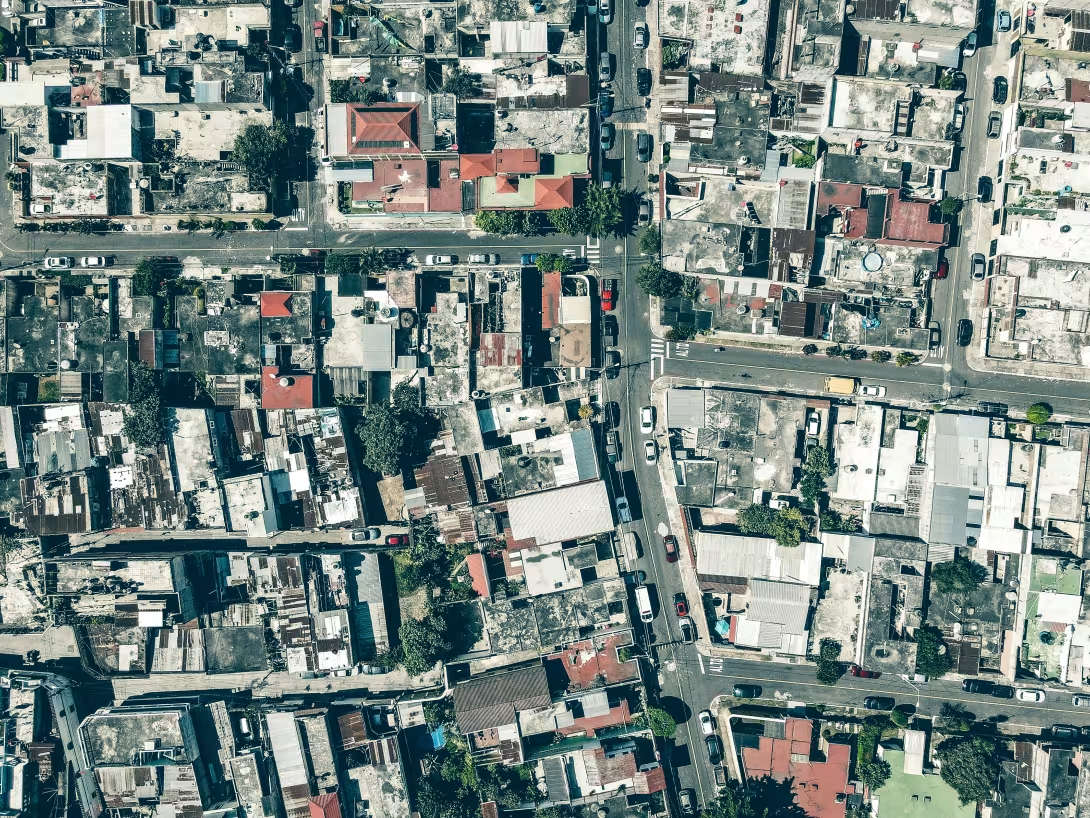
Photo by Christopher Garcia / Unsplash
Guatemala is an active participant in the GEF-8 Sustainable Cities Integrated Program (SCIP), with the Guatemala City Metropolitan Area and secondary cities such as Huehuetenango advancing integrated, climate-responsive urban development. As one of Central America’s most ecologically diverse countries, Guatemala faces pressing urban challenges—from rapid expansion and informal growth to rising climate risks, water stress, and environmental degradation.
Through SCIP and the GPSC Global Knowledge Platform, Guatemalan cities are strengthening metropolitan governance, enhancing land-use planning, and expanding nature-based solutions to improve resilience. The program also supports the creation of a Sustainable Cities Coalition, fostering coordination across municipalities and national agencies. Guatemala’s engagement offers valuable lessons for the global GEF network, particularly on integrating biodiversity, territorial planning, and climate adaptation in rapidly growing urban regions.
IUCN serves as the Implementing Agency. The Executing Agencies are the Ministry of Environment and Natural Resources and the Vice Ministry of Housing and Urban Development.
The project operates at national and metropolitan scales, promoting integrated and inclusive planning, sustainable mobility, circular economy models, improved watershed and landscape management, and financial instruments for resilient infrastructure. Activities include developing urban environmental observatories, strengthening intermunicipal governance, planning green corridor networks, enabling private-sector engagement in sustainable mobility and waste management, and designing incentives such as payments for ecosystem services and land-value capture mechanisms.
Knowledge sharing and capacity building are central, supported by local institutions, private actors, academia, and global networks.
Component 1 – Integrated Planning, Strategies and Policies
- Urban Forest Law implementation support, including drafting regulations and city-level green mapping for ecological corridors
- National Construction Code reform with environmental sustainability, energy efficiency, safety and accessibility standards
- Technical guide for integrating biodiversity and blue–green infrastructure into POTs (Land Use Plans) aligned with GBF Target 12
- Multi-level Urban Planning & Investment Coordination Roundtable for NbS and biodiversity integration into public investment pipelines
- Sustainable Urban Drainage Systems (SUDS) strategy design for Guatemala City (Great Green District) focusing on aquifer recharge
- Municipal POT preparation and approval (Fraijanes, Amatitlán) integrating green infrastructure and risk mitigation
- Territorial ecosystem diagnostics and ecosystem services mapping (InVEST tool) for AMCG and Huehuetenango
- Participatory Local Territorial Plan for Huehuetenango water recharge zone, prioritizing urban forest and watershed management
Component 2 – Mobilizing Investments in Resilient and Nature-Positive Urban Development
- Adaptation of national public funds (FONCC, FONACON) to finance urban biodiversity and NbS
- Design of Biodiversity & Urban Forest Fund financing framework
- Fiscal-legal diagnostics for municipal green finance instruments
- Design of land value capture and compensation schemes for NbS financing
- Pilot implementation of local green finance mechanisms in selected municipalities
- Urban ravine ecological restoration investments in Guatemala City with inclusive public space design
- Water recharge zone restoration investments in Huehuetenango Municipal Regional Park (Manantiales Reserve)
- Strengthening municipal green park system in Huehuetenango for biodiversity and inclusive public space management
Component 3 – Knowledge Management on Urban Biodiversity and NbS
- National Community of Practice on Urban Biodiversity and NbS (minimum 50% women participation)
- Capacity building programs for municipalities on urban biodiversity and climate action
- Citizen urban–nature monitoring platform (Guatemala City) in partnership with universities
- Urban innovation and citizen science lab (Huehuetenango) coordinated with SEGEPLAN
- Urban sustainability observatory development for biodiversity and climate-informed decision-making
- Improved integrated land-use planning frameworks in two metropolitan areas.
- Green corridors and restored ecosystems spanning 71,902 ha under improved practices.
- Strengthened water resource management and reduced aquifer stress.
- Climate mitigation of approx. 3.7 million tCO₂e.
- Enhanced waste management and circular economy transitions.
- Local and national governance platforms operational and better coordinated.
- New financial instruments designed for resilient urban development.
- Metropolitan observatory established for biodiversity and climate data.
- 120,000 direct beneficiaries, including gender-balanced participation.
Total GEF Grant (USD)
7,999,998
Total Co-financing (USD)
166,000,000
World Bank Country Profile (Data Portal)
For broader socioeconomic and environmental context, consult the World Bank Country Data Profile. It provides up-to-date indicators on economic performance, social development, climate and environmental metrics, as well as an overview of World Bank operations and financing in the country. Access the country profile here.
GEF Country Profile
For information on Global Environment Facility engagement, see the GEF Country Profile. It presents an overview of GEF-funded projects, thematic areas of intervention, implementing partners, and country resource allocations, offering insight into environmental investment priorities and ongoing initiatives. Access the country profile here.
WOFI Country Profile
For additional insights on subnational public finance, see the OECD Subnational Government Finance Observatory (WOFI) Country Profile. It provides internationally comparable data on revenues, expenditures, investment, debt, and fiscal arrangements across levels of government, offering a useful reference on fiscal capacity and decentralization. Access the country profile here.
Theme
Keywords