

Cuba
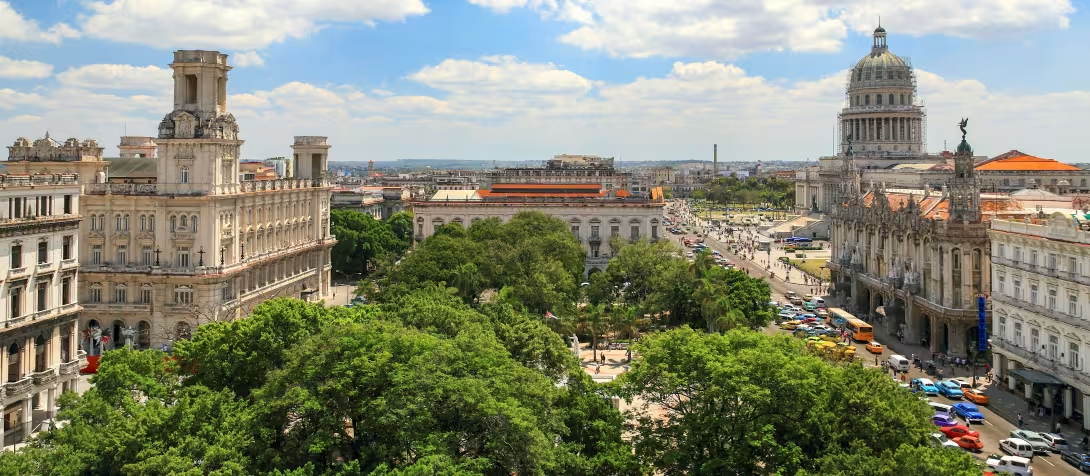
Cuba participates in the GEF-8 Sustainable Cities Integrated Program (SCIP) through the Havana Province metropolitan area, advancing integrated planning and climate-resilient urban development. As one of the Caribbean’s largest and most culturally significant urban regions, Havana faces challenges linked to aging infrastructure, exposure to climate risks, and the need for greener, more efficient urban services.
Through SCIP and the GPSC Global Knowledge Platform, Cuba is developing a knowledge and investment framework that supports nature-based solutions, decarbonized infrastructure, circular economy measures, and strengthened urban governance. These efforts aim to mobilize public and private finance for resilient, inclusive urban transformation. Cuba’s engagement provides important learning for the wider GEF network, particularly in adapting coastal cities to climate impacts while preserving cultural heritage and social cohesion.
UNDP serves as the Implementing Agency. The Executing Agency is the Government of Havana Province.
The project adopts an integrated approach to urban sustainability by strengthening governance, regulatory frameworks and planning instruments, and by establishing a geospatial information platform for land-use, climate-risk, and biodiversity management. It will demonstrate low-emission mobility solutions and improved last-mile connectivity and will pilot energy-efficient and renewable energy measures in priority public health facilities.
The project will also apply circular-economy models for municipal solid waste management and restore urban and peri-urban ecosystems, including green corridors and nature-based solutions to reduce flood and storm risk and support sustainable local food systems. Knowledge generation, city-to-city learning and South–South cooperation will be promoted through the Global Platform for Sustainable Cities (GPSC), supported by a robust monitoring, evaluation and safeguards framework.
Component 1 – Governance for Integrated Urban & Territorial Planning
- Establishment of a multi-level, inter-institutional coordination mechanism for integrated planning in Havana.
- Preparation and updating of key strategic and regulatory instruments (integrated development strategy, urban territorial plan, waste and mobility plans, ecosystem connectivity and innovative financing).
- Design and operationalization of a geospatial information platform and capacity-building programmed with a strong gender and social inclusion focus.
Component 2 – Low-Emission Mobility & Built Environment Systems
- Design and demonstration of low-carbon mobility solutions within Havana’s Sustainable Urban Mobility framework, including active and electric mobility and improved last-mile connectivity.
- Energy audits and implementation of efficiency and renewable energy measures in selected public health facilities.
- Development of technical tools and guidelines to support the scaling of these solutions.
Component 3 – Circular Economy for Solid Waste Management
- Stratified diagnostics and hotspot mapping of solid waste generation and management in selected municipalities.
- Design and implementation of a circular‑economy pilot involving public, private and community actors, promoting women’s economic empowerment.
Component 4 – Nature-Positive Urban & Territorial Systems
- Design of an urban and peri-urban green corridor and ecosystem-connectivity plan, including priority areas such as the Almendares River basin.
- Ecological restoration and sustainable land- and forest-management interventions to establish and maintain green corridors and connected green spaces.
- Promotion of sustainable urban agriculture and guidance on nature-based solutions for flood and storm-risk reduction.
Component 5 – Knowledge, Capacity & City-to-City Learning
- Establishment of a community of practice and mechanisms for knowledge exchange on sustainable urban development.
- Development of targeted knowledge products and participation in city-to-city exchanges and South–South cooperation through the GPSC.
Component 6 – Monitoring, Evaluation & Safeguards
- Design and implementation of a monitoring and evaluation system for project performance and global environmental benefits.
- Implementation of a gender action plan and social inclusion measures.
- Application of UNDP’s Social and Environmental Standards, including comprehensive safeguard management.
- Strengthened multi-level governance and integrated urban and territorial planning across the 15 municipalities.
- An operational geospatial information and decision-support platform for land-use, environmental and climate-risk management.
- Demonstrated low-carbon mobility solutions with improved, low-emission and active mobility services.
- Improved energy efficiency and increased renewable energy use in at least three public health facilities.
- A circular-economy pilot for municipal solid waste implemented and generating lessons for replication.
- Establishment of an urban biodiversity corridor with 2,000 ha restored and 1,500 ha under improved sustainable management.
- Direct mitigation benefits are estimated at approximately 100,000 tCO2e during the implementation period and 862,617 tCO2e over the lifetime of the investments.
- Around 62,270 direct beneficiaries (35,710 women and 26,560 men) benefiting from lo carbon mobility, energy-efficient health services, circular-economy interventions and nature-based solutions.
Total GEF Grant (USD)
8,666,663
Total Co-financing (USD)
33,340,000
World Bank Country Profile (Data Portal)
For broader socioeconomic and environmental context, consult the World Bank Country Data Profile. It provides up-to-date indicators on economic performance, social development, climate and environmental metrics, as well as an overview of World Bank operations and financing in the country. Access the country profile here.
GEF Country Profile
For information on Global Environment Facility engagement, see the GEF Country Profile. It presents an overview of GEF-funded projects, thematic areas of intervention, implementing partners, and country resource allocations, offering insight into environmental investment priorities and ongoing initiatives. Access the country profile here.