

Transit-Oriented Development Implementation Resources and Tools (Portuguese)
15 JULY 2024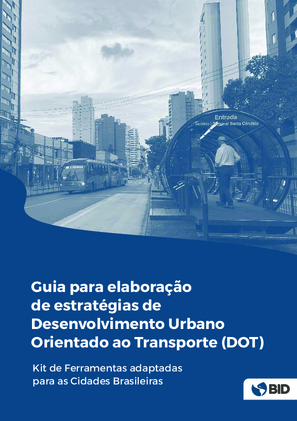
The Transit-Oriented Development (TOD) Toolkit provides a comprehensive set of resources to support public officials, practitioners, and urban stakeholders throughout all phases of the TOD process: assessing, enabling, planning and design, financing, and implementation. This version has been translated and adapted specifically for the context of Brazilian cities, based on the original GPSC TOD Toolkit, with financial support from the Inter-American Development Bank (IDB). The adaptation reflects Brazil’s institutional, regulatory, and urban development realities, making the toolkit more accessible and actionable for municipalities with varying capacities and contexts.
Transit-Oriented Development (TOD) is an integrated urban planning approach that promotes compact, mixed-use development centered around high-capacity public transport systems, encouraging public transit, walking, and cycling as primary modes of mobility. It focuses on concentrating density, services, and activities within a 5–10 minute walking radius of transit stations, while enhancing urban spaces and ensuring convenient access to a diverse mix of land uses. By bringing together land use and transport planning, urban design, regeneration, real estate development, financing mechanisms, land value capture, and infrastructure delivery, TOD supports more inclusive, resilient, and sustainable cities. Given its complexity, the toolkit offers practical guidance, analytical and communication tools, case studies, and reference materials to enable informed decision-making and effective implementation in the Brazilian context.