

Cities are the source of over 70 percent of the world’s greenhouse gas emissions. Cities are also the engines of the global economy, concentrating more than half the world’s population. By the year 2050, two-thirds of the world will be urban, with cities accommodating an additional 2.5 billion people over today’s total. Nearly all of this urban growth will occur in developing countries. This concentration of people and assets also means that the impacts of natural disasters, exacerbated by the changing climate, may be even more devastating, both in terms of human lives lost and economic livelihoods destroyed. Earth is on a trajectory of warming more than 1.5°C unless important decarbonizing steps are taken.
Often urban policymakers prescribe integration as the solution to steering urbanization towards decarbonization to achieve greater global and local environmental benefits. However, little is known about the struggles—and successes—that cities in developing countries have in planning, financing, and implementing integrated urban solutions.
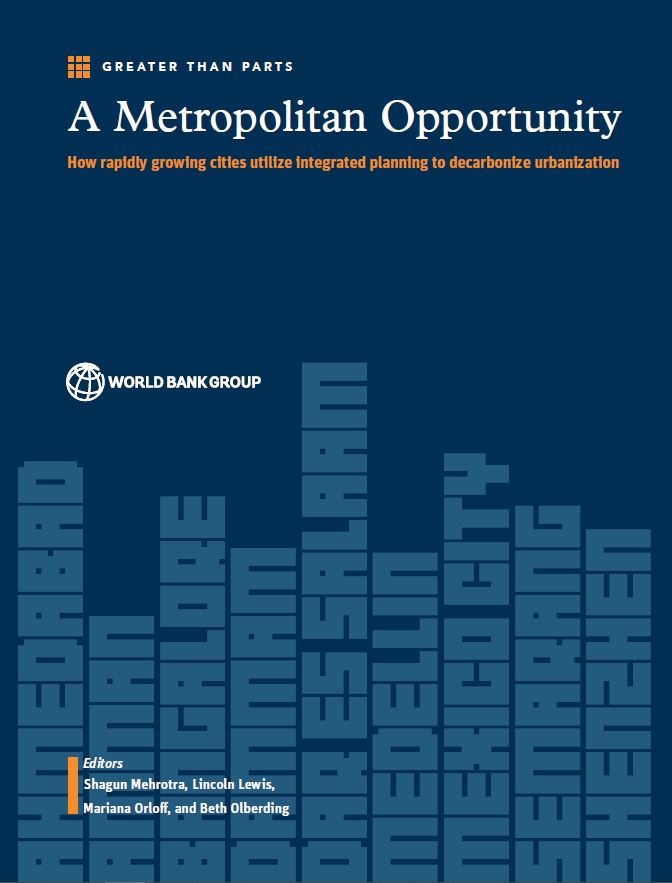
Greater Than Parts: A Metropolitan Opportunity presents nine diverse metropolitan areas as individual case studies each with a selection of urban innovations. From the analysis, the report derives models, poses guiding questions, and presents key principles to provoke and inspire action by cities around the world.
The main objective of this report is to understand how developing and emerging economies are successfully utilizing horizontal integration—across multiple infrastructure sectors and systems—at the metropolitan scale to deliver greater sustainability. Integrated planning processes extending well beyond city boundaries are examined to determine how they have been financed and implemented. The report’s primary audience is therefore city decision makers, their financiers, technical advisers, and practitioners most interested in applying integrated approaches to sustainable urban planning in capacity-constrained environments.
Work on this report was led by the World Bank’s Global Platform for Sustainable Cities (GPSC), with contributions from the World Resources Institute (WRI), and supported by the Global Environment Facility (GEF) through the Sustainable Cites Integrated Approach Pilot, and the Kingdom of Saudi Arabia for the case study of Dammam.
Directly download the report documents here: