

Making the Business Case for Nature-Based Infrastructure: How the City of Cape Town boosted funding for restoring its waterways
03 MARCH 2026 /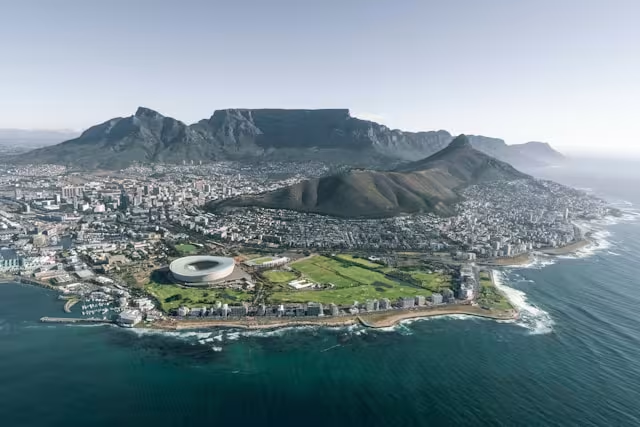
The City of Cape Town is investing in nature-based infrastructure (NBI) to restore its degraded rivers and wetlands. When funding was under pressure, the International Institute for Sustainable Development’s (IISD’s) NBI Centre supported the city with two integrated cost–benefit analyses (CBAs). By translating environmental, social, and economic benefits into clear evidence, the analyses helped strengthen the investment case, moving projects toward implementation.
From the mountain slopes and Cape Flats to the coast, the rivers of the Sand and Zeekoe catchments weave through the City of Cape Town before reaching estuaries like Zandvlei and Zeekoevlei. These vleis (a local phrase for shallow lakes) have long been places where residents and visitors sail, fish, and watch birds, while the waterways themselves carry stormwater and shield neighbourhoods from floods. But years of urban growth, pollution, and climate stress have clogged the waterways and weakened their natural defences.
Currently, the city is busy with the dredging of Zeekoevlei, its first in more than 40 years, to improve water quality in two sections. While this will bring short-term relief, underlying problems of upstream pollution and sedimentation remain.
To respond to these water, climate change, and environmental challenges, the City of Cape Town developed its Water Strategy, which aims to make Cape Town a water-sensitive city by 2040. Central to this strategy are the Green Infrastructure Programme and the Liveable Urban Waterways (LUW) Programme, designed to rehabilitate rivers and wetlands through water-sensitive design and NBI.
However, in early 2024, the LUW Programme suffered a major setback. Funding for four of its five projects was deferred due to budget constraints, and projects were pushed back to 2033. From the ZAR 50 million (USD 2.9 million) originally allocated, only ZAR 10 million (USD 600,000) remained, and the four projects were put on hold.
How the NBI Centre Contributed
In the months that followed, advocacy and lobbying intensified. A public petition gained traction, and the Mayor’s advisory committee recommended that the budget be restored. Alongside the advocacy push, IISD’s NBI Global Resource Centre carried out an integrated CBA of LUW projects in the Diep/Sand and Zeekoe catchments, with technical assistance coordinated by the C40 Cities Finance Facility. The work gave the city something it had previously lacked: robust economic evidence. While the analysis did not cover the delayed projects directly, it demonstrated a clear economic case for investing in waterway rehabilitation.
Using IISD’s Sustainable Asset Valuation (SAVi) approach, the assessment went beyond traditional economic analyses by integrating the wider social, economic, and environmental benefits of the planned projects. It linked ecosystem services to budget impacts, showing how rehabilitating waterways could lower dredging and canal repair costs, reduce flood damage, and deliver social and environmental co-benefits such as jobs, recreation, and biodiversity gains. It also tested climate scenarios to understand how the NBI would respond to different climate futures.
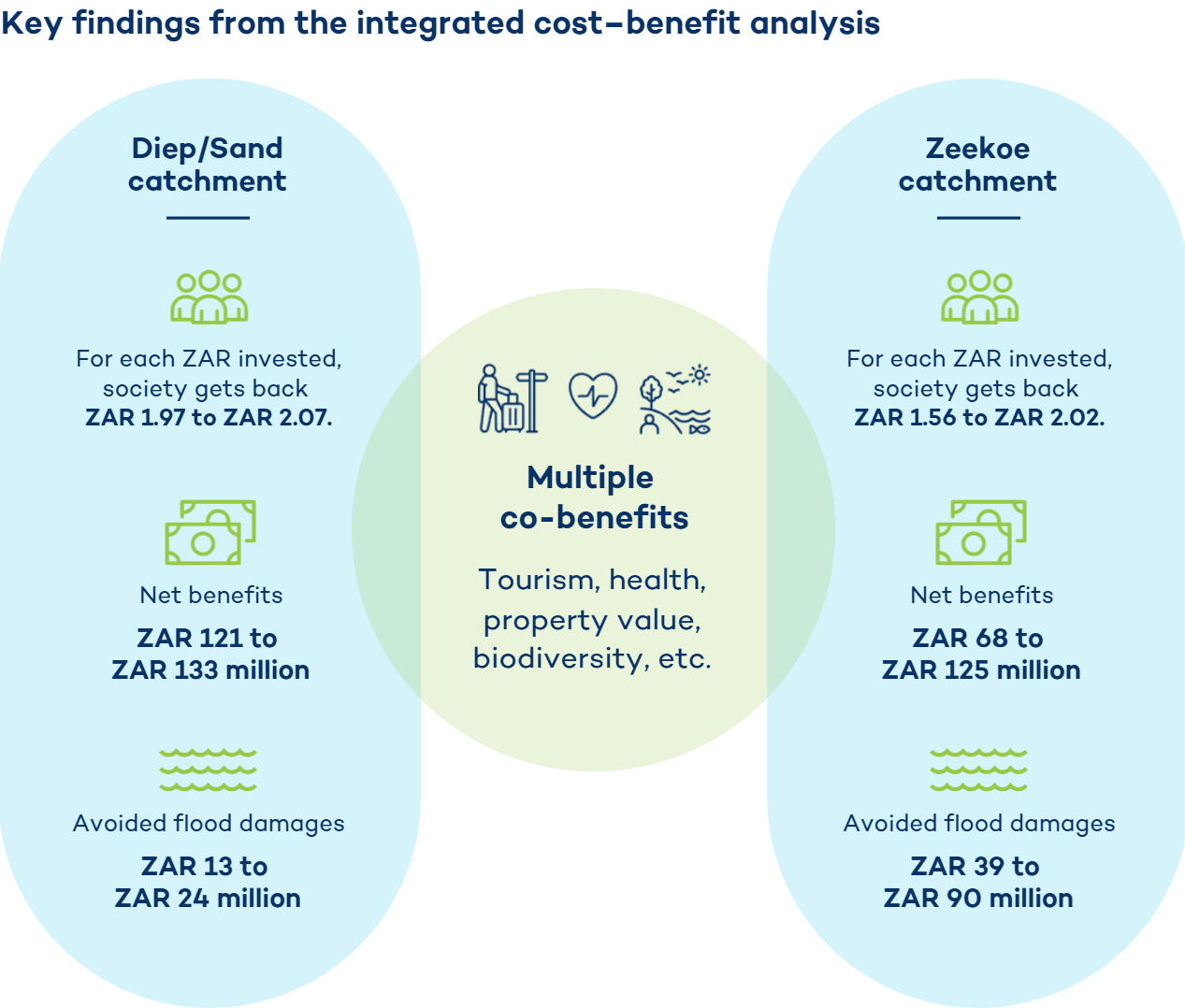
The numbers told a clear story. In the Diep/Sand catchment, every rand invested would generate almost two rand in benefits, with net gains of up to ZAR 133 million (USD 7.6 million) by 2050. In Zeekoe, each rand invested would generate between 1.6 and just over 2 rand, with net benefits ranging from ZAR 68 million to ZAR 125 million (USD 3.9–7.1 million). Across both catchments, the projects would save up to ZAR 55 million (USD 3.1 million) on dredging and canal refurbishment, safeguard tourism and property revenues, and create about 60 local jobs each year. Under pessimistic climate scenarios, the benefits grew even stronger as avoided flood damages became more valuable.
By translating ecological improvements into economic terms through avoided costs, along with benefit–cost ratios, the SAVi assessment made the investment case for NBI tangible.
Projects Moving Toward Implementation
In July 2025, the City of Cape Town approved ZAR 99 million (USD 5.6 million) for LUW projects over the next 3 years, with a further ZAR 91 million (USD 5.1 million) earmarked beyond that, nearly ZAR 200 million (USD 11.4 million) in total.
The deferred projects are now recommencing and are expected to complete their detailed design phase over the next 2 years. The Sand Langevlei project (which was not pushed back) is the first to move toward construction, with the other four projects set to follow. Planned measures include wetland creation, canal naturalization, stormwater ponds, riparian rehabilitation, and improved public spaces. All projects have been co-designed with local communities, through 15 stakeholder workshops involving more than 800 participants.
With momentum regained, the city is now turning to the next phase. The LUW Programme covers around 40 projects across multiple catchments. Two of these catchments represent about half of the total program costs, requiring more than ZAR 1 billion (USD 57 million) in capital investment. The city plans to apply the same cost–benefit approach used by IISD to build the case for future investments.
The Diep/Sand and Zeekoe projects are part of the next phase of the LUW Programme, drawing on earlier work with the C40 CFF and IISD.
Making the Case for NBI
For Cape Town, the integrated CBAs strengthened the case for waterway rehabilitation as both an environmental and economic investment. It also proves valuable that city staff learned about developing, interpreting, and communicating about CBAs, both through the co-creation of the analyses and in-person trainings held by IISD.
The SAVi report is already being used in roadshows with senior decision-makers, presenting headline numbers that explain how restoration can protect budgets as well as neighbourhoods.
By applying this kind of economic evidence, Cape Town is offering a practical example for other cities seeking to invest in NBI.