

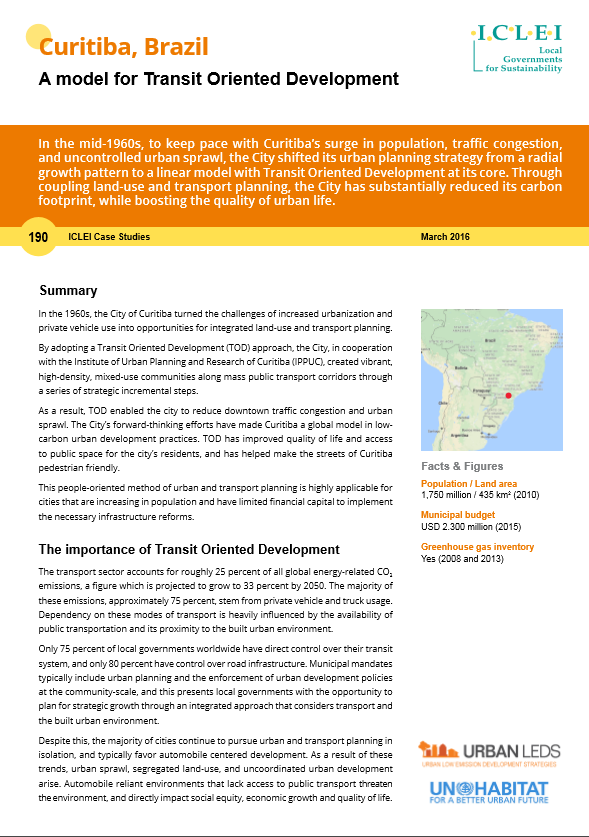
A model for Transit Oriented Development: Curitiba, Brazil

February 29, 2016

In the mid-1960s, to keep pace with Curitiba’s surge in population, traffic congestion, and uncontrolled urban sprawl, the City shifted its urban planning strategy from a radial growth pattern to a linear model with Transit Oriented Development at its core. This study depicts how TOD enabled Curitiba to reduce downtown traffic congestion and urban sprawl, and improve quality of life and access to public space for the residents. The City’s forward-thinking efforts have made Curitiba a global model in low carbon urban development practices. This people-oriented method of urban and transport planning is highly applicable for cities that are increasing in population and have limited financial capital to implement the necessary infrastructure reforms. 
Partners

Cities

Countries

Theme

Downloads

Download
Related content
View all

Mobility

TOD City Academy

The event was a two-day interactive workshop, organized within the framework of GPSC’s 3rd Global Meeting, that brought together government officials from 12 Latin American and Caribbean cities and 4
Knowledge Product

Learn more

Mobility

Transforming Cities with Transit: Transit and Land-Use Integration for Sustainable Urban Development

This study explores the complex process of transit and land-use integration in rapidly growing cities in developing countries. It first identifies barriers to and opportunities for effective

Knowledge Product

Learn more

Mobility

[VIDEO] Cities are Taking on Electric Buses: How the FSCI Helps Accelerate the Transition

Each day, a quarter million people around the world rely on diesel-fueled buses to reach their destinations. For decades, these buses have been the backbone of public transit fleets in cities. But

Knowledge Product

Learn more