

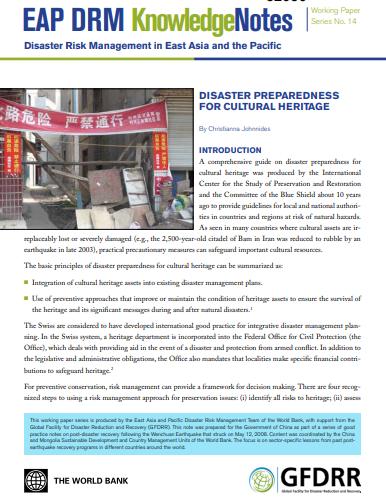
Disaster Preparedness for Cultural Heritage

December 27, 2010

A comprehensive guide on disaster preparedness for cultural heritage was produced by the international center for the study of preservation and restoration and the committee of the blue shield about 10 years ago to provide guidelines for local and national authorities in countries and regions at risk of natural hazards. As seen in many countries where cultural assets are irreplaceably lost or severely damaged (e.g., the 2,500-year-old citadel of Bam in Iran was reduced to rubble by an earthquake in late 2003), practical precautionary measures can safeguard important cultural resources. For preventive conservation, risk management can provide a framework for decision making. There are four recognized steps to using a risk management approach for preservation issues: (i) identify all risks to heritage; (ii) assess the magnitude of each risk; (iii) identify possible mitigation strategies; and (iv) evaluate the costs and benefits associated with each strategy.
Related content
View all

Culture

Resilient Cultural Heritage: Learning from the Japanese Experience

Japan’s cultural heritage (CH) is among the richest in the world, but the country is faced with some of the most difficult challenges in its exposure to hazards. With earthquakes, volcanic eruptions
Knowledge Product

Learn more

Culture

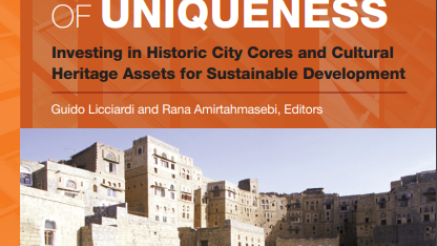
The Economics of Uniqueness: Investing in Historic City Cores and Cultural Heritage Assets for Sustainable Development

With rapid urbanization, cities featuring valuable historic cores and heritage assets struggle to modernize without completely losing their uniqueness. The good news is that there is an increasing
Knowledge Product

Learn more

Culture

Building Back Stronger: Urban Resilience Through Post-Conflict Reconstruction

Rebuilding cities and towns after protracted conflict is a more common occurrence than many would find acceptable. It is also a policy challenge that can either exacerbate or help alleviate simmering
Knowledge Product

Learn more