

Market Study for the Philippines: Plastics Circularity Opportunities and Barriers
21 MARCH 2021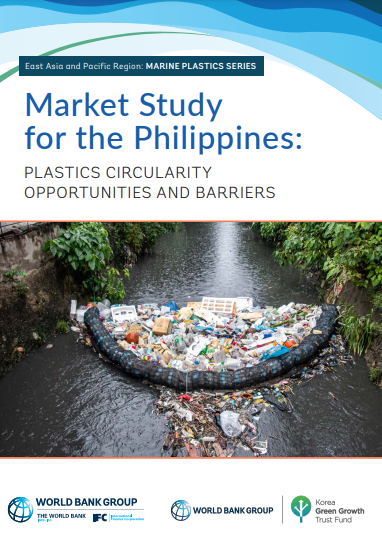
Mismanaged plastic waste has growing economic and environmental consequences. USD 80-120 billion worth of plastic packaging is lost from the global economy each year due to lack of recycling and suboptimal value creation where recycling exists. Globally, 4.8 to 12.7 million tonnes of plastic leak into our oceans each year with Asia contributing to over 80 percent of this marine leakage. The Philippines is the third largest contributor with an estimated 0.75 million metric tons of mismanaged plastic entering the ocean every year. This has led to an increased awareness towards plastic waste management, bringing the topic of plastic pollution to the forefront of consumer consciousness in the Philippines.
To address the challenge of plastic waste management, the Philippines is currently developing new strategies. The National Plan of Action on Marine Litter, under development by the Department of Environment and Natural Resources (DENR) with support of UNDP Philippines, is currently being finalized. The plan recognizes the need for more concerted and unified efforts from various stakeholders to tackle the problem of marine litter.
The National Economic and Development Authority (NEDA) published The Philippine Development Plan (PDP) 2017-2022 targeting a national waste diversion rate of 80 percent by 2022. This will be primarily achieved through the enforcement of the Ecological Solid Waste Management Act RA9003—an integrated solid waste management plan based on the 3Rs (reduce, reuse and recycle). Furthermore, in 2019, NEDA published the Philippine Action Plan for Sustainable Consumption and Production (PAP4SCP) to improve waste management and plastic circularity.
This study addresses the critical need for a private sector focused market assessment of plastics recycling in the Philippines. Reuse, refill and new delivery model aspects of a circular economy for plastics are evaluated, but the primary focus of the study is plastic recycling, where scalable private sector investment solutions are greatest.