Ningbo Launches Biodiversity Index and Advances Urban Conservation Efforts
25 MAY 2026 /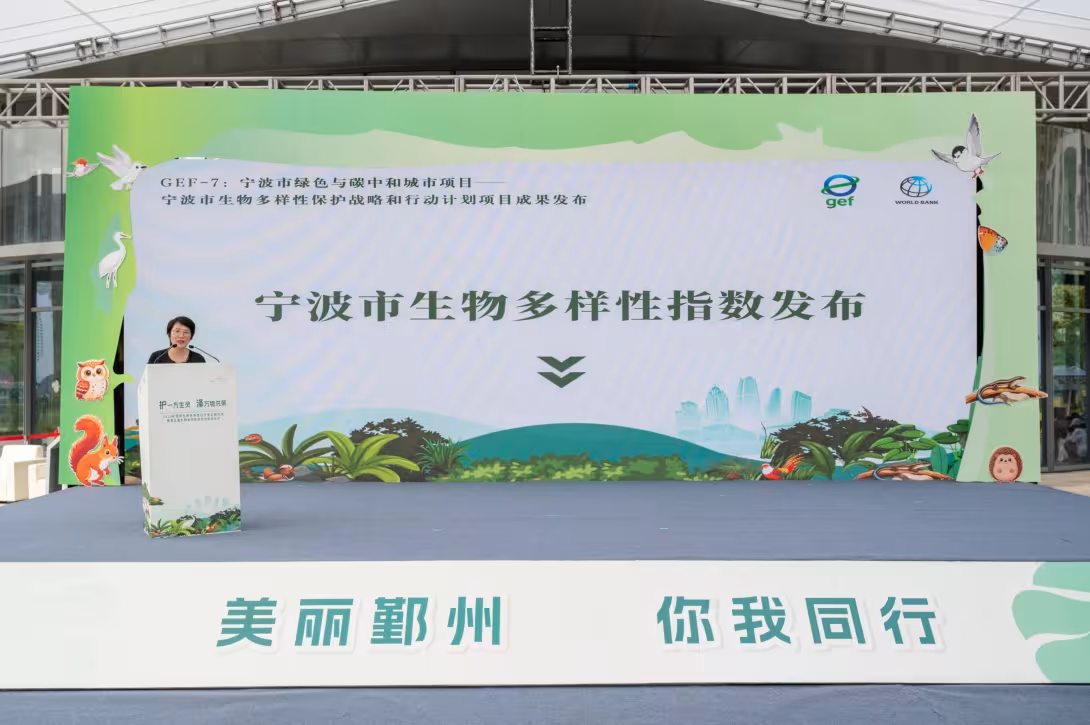
On May 19, 2026, the Ningbo theme event for the International Day for Biological Diversity and the launch ceremony of the Fifth Biodiversity Experience Month were held at Ningbo Children’s Park under the theme “Protecting Life, Enabling Shared Prosperity for All Living Things.” The event showcased the key achievements of Ningbo in urban biodiversity conservation under the support of the Global Environment Facility (GEF) and the World Bank, highlighting the city’s efforts to translate international best practices into local ecological governance and action.
The GEF-funded China Green and Carbon Neutral Cities Project (GEF-7 Project) became effective on September 7, 2022, and is scheduled to close in June 2027. As one of the participating cities, Ningbo received a grant of US$5.51 million to implement ten activities across four thematic areas: high-quality development indicator frameworks, natural ecosystems, low-carbon development, and green finance. Among these, the urban biodiversity conservation component launched in May 2024 and has now fully achieved its intended objectives, delivering breakthrough progress in strategic planning, scientific assessment, monitoring systems, and demonstration initiatives.
Establishing Strategic Direction through Policy Leadership
A major milestone was the release of the Ningbo Biodiversity Conservation Strategy and Action Plan (2025–2035), jointly issued by six government departments including the ecological environment authority in June of last year. This ten-year action framework establishes a “5+8+28+18+28” conservation system, identifying five priority conservation areas, focusing on eight priority sectors, and setting out 28 priority actions, 18 priority indicators, and 28 priority projects. The strategy provides a clear and targeted roadmap for biodiversity conservation over the coming decade.
Building a Comprehensive Biodiversity Baseline
Ningbo completed a citywide biodiversity baseline inventory documenting 7,980 species, including 210 nationally protected species. This work achieved systematic integration across all taxonomic groups, geographic areas, and stages of biodiversity management, creating a robust scientific foundation to support future policy and planning decisions.
Launching the Ningbo Biodiversity Index
Drawing on the experience of the Singapore City Biodiversity Index, Ningbo developed the Ningbo Biodiversity Index, consisting of five dimensions and 29 core indicators. The index establishes a comprehensive assessment framework that is quantifiable, trackable, and comparable, addressing a previous gap in biodiversity evaluation methodologies. During the event, the city released the 2026 Ningbo Biodiversity Index assessment results, representing the first systematic citywide evaluation conducted using this methodology. This marks an important transition in Ningbo’s ecological governance, moving from experience-based assessment toward data-driven and precision ecological management.
Strengthening Monitoring and Digital Intelligence
Ningbo also completed and delivered the Ningbo Biodiversity Monitoring Framework, which establishes a “1+5+N” integrated observation network. The framework defines standardized monitoring indicators and technical protocols for different biological groups and is supported by a digital smart monitoring platform. Together, these tools provide essential technical support for unified data collection, efficient management, and in-depth analysis of biodiversity information across the city.
Advancing Biodiversity-Friendly Pilots and Demonstration Models
Under the GEF-7 project, biodiversity-friendly pilot initiatives have accelerated significantly. Xiangshan, Yinzhou, and Beilun were selected among the first provincial pilots for biodiversity-friendly city development. At the same time, the first group of 11 biodiversity-friendly units received official recognition, while enterprises such as Ningbo Iron and Steel and Zhenhai Refining & Chemical were designated as “biodiversity-friendly enterprises,” demonstrating the potential for harmony between industrial activity and nature.
Additional achievements included the designation of five new municipal biodiversity experience sites, the launch of the Yinzhou Urban Biodiversity Digital Map, and the establishment of the Little Bee Ecological Fund. Together, these initiatives illustrate a growing model of broad public participation in biodiversity conservation.
The event was jointly organized by the Ningbo Municipal Bureau of Ecology and Environment and the Yinzhou District People’s Government, with participation from approximately 70 representatives from planning, housing, and other government agencies and related institutions. The Biodiversity Experience Month activities launched alongside the event also attracted strong public engagement, reflecting growing public awareness of and commitment to ecological conservation.
Looking ahead, Ningbo plans to strengthen synergies among the various GEF-7 project components, promoting wider application of green and low-carbon innovations and generating catalytic impacts. Through these efforts, the city aims to provide replicable and scalable experience to support green urban transformation.