Sustainable Asset Valuation Assessment of Nature-Based Solutions in Kigali, Rwanda
20 JANUARY 2026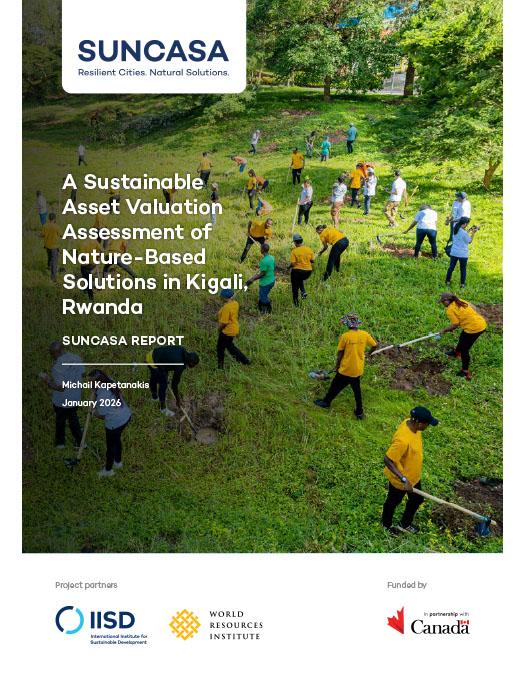
This Sustainable Asset Valuation (SAVi) assessment evaluates the economic, social, and environmental performance of nature-based solutions (NbS) implemented under the SUNCASA project. Using an integrated cost–benefit analysis, the report quantifies how afforestation, reforestation, agroforestry, riparian restoration, and urban tree planting can reduce flood damage, improve public health, create jobs, and strengthen Kigali’s long-term climate resilience.
Kigali faces mounting climate and development pressures. Rapid population growth and urban expansion have increased surface runoff and soil erosion, while climate change is intensifying extreme rainfall and heat. Floods and landslides regularly damage homes, roads, and public infrastructure, as well as degrade water quality and pose serious health risks, particularly in informal and low-income settlements.
To address these challenges, the Scaling Urban Nature-based Solutions for Climate Adaptation in Sub-Saharan Africa (SUNCASA) project supports gender-responsive NbS across Kigali. Implemented by the International Institute for Sustainable Development and the World Resources Institute, the project promotes afforestation and reforestation, agroforestry, riparian buffer restoration, and urban tree planting to restore ecosystems and reduce climate risks. The interventions target 2,500 hectares across six critical micro-catchments, including the planting of 85,000 urban trees.
The Nature-Based Infrastructure Global Resource Centre conducted a SAVi assessment to evaluate the full life-cycle costs and benefits of these NbS interventions compared to a business-as-usual scenario.
The results show that investing in nature delivers strong and resilient returns. Over a 25-year period, NbS in Kigali generate benefits more than twice their costs, with a payback period of just 7 years. The largest gains come from avoided flood damage to urban infrastructure, protecting hundreds of buildings and critical road networks, alongside major reductions in health costs linked to water pollution, floods, and heat.