

The World Bank and the GEF launch next phase of Sustainable Cities Integrated Program
10 DECEMBER 2025 /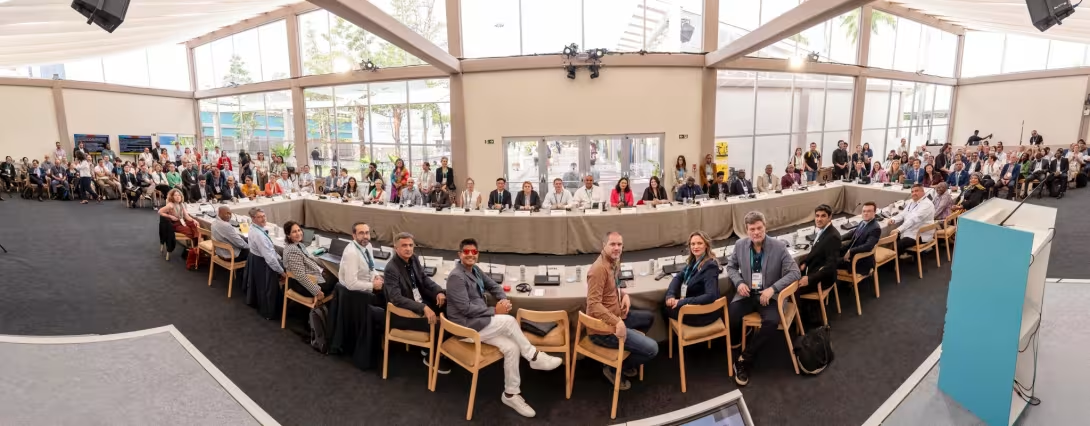
The World Bank and the GEF expand support to 40 additional cities with targeted grants and co-financing pathways to drive sustainable urban development
Mayors and city leaders from 23 cities met in Rio de Janeiro ahead of COP30 alongside representatives from major multilateral development banks to launch the next phase of the Global Environment Facility (GEF) Sustainable Cities Integrated Program.
“Cities are at the forefront of sustainability, leadership and innovation,” said GEF CEO Carlos Manuel Rodriguez, opening the event. “Complex environmental challenges demand integrated, systematic solutions—and cities are uniquely positioned to deliver them.”
Since 2016, the Sustainable Cities Program has provided $480 million in GEF grants, reaching more than 90 cities across 34 countries. These grants have driven an estimated nearly $6 billion in co-financing for transformative urban projects. The new phase GEF-8 will add 40 cities in 20 countries with $170 million in new grant financing.
How the Program Works
This new program phase will be implemented by the World Bank through the Global Platform for Sustainable Cities (GPSC), with a focus on providing cities with peer-informed knowledge, advanced tools, and proven methodologies to invest in sustainable urban development.
The program’s hallmark is a dual-track model that combines grant financing with global knowledge, delivered through GPSC. This ensures global best practices and research flow directly into city-level project design, turning innovative ideas into scalable, fundable solutions.
“By embedding knowledge generation and peer learning into every stage of project development, GPSC helps cities translate ambition into tangible action,” explained Ming Zhang, the World Bank’s Global Director for Urban, Resilience, and Land.
Cities at the forefront of climate action
The new program phase was launched at the GPSC Mayors’ Roundtable and Urban Nature Forum, co-hosted by the International Finance Corporation (IFC) on the sidelines of the COP30 Local Leaders’ Forum in Rio from November 3-5, 2025.
These events brought together city leaders, technical experts, and global partners for two days of dialogue, peer learning, and technical exchange. Cities showcased projects implemented under the Sustainable Cities Integrated Program with GEF support, sharing successes, lessons, and insights. For example:
- Belize City, Belize – Belize City is working to safeguard its coastal environment while strengthening the resilience of communities that depend on it, focusing on better land-use planning, cleaner waterways, and the protection of vital marine ecosystems that underpin its Blue Economy. Through the GEF-8 Program, the city is deepening this strategy by improving drainage and sanitation systems, restoring coastal habitats, and integrating blue-green infrastructure into urban development. This support is helping Belize City scale up its efforts to reduce pollution, enhance climate resilience, and build a more sustainable foundation for coastal growth.
- Brazzaville, Republic of Congo – Brazzaville is prioritizing greener urban growth by addressing land degradation, flooding, and erosion risks that threaten communities. GEF-8 strengthens this strategy through targeted neighbourhood upgrades and nature-based solutions, while also improving institutional capacity and planning processes to help the city scale its long-term vision for resilient development.
- Ulaanbaatar, Mongolia - Ulaanbaatar is striving to confront the environmental pressures of rapid urbanization, from severe winter pollution to flooding and growing waste, while creating greener, more liveable neighbourhoods, especially in ger districts. Through GEF-8, the project supports this vision by expanding nature-based flood protection, improving urban waste and water systems, promoting clean energy solutions, and increasing green public spaces. The program also helps strengthen policy frameworks and local capacities, ensuring the city can scale up integrated, climate-smart planning and accelerate Mongolia’s wider green urban transition.
To widen opportunities for learning, GPSC “Lighthouse Cities”—partner cities outside the Sustainable Cities Integrated Program—also shared how they have financed sustainable urban projects. For example, Bogotá, Colombia highlighted its pioneering $600 million international sustainability bond, financing rail, bus, and aerial cable transportation systems with support from the World Bank and IFC.
Representatives from the Development Bank of Southern Africa (DBSA), European Bank for Reconstruction and Development (EBRD), Inter-American Development Bank (IDB), IFC, and the World Bank also shared strategies to boost project bankability. Cities were encouraged to strengthen municipal borrowing frameworks and de-risk investments to unlock sustainable finance at scale.
Looking ahead
As cities continue to grow, challenges such as resource consumption, biodiversity loss, and urban pressures demand integrated, systems-based solutions. This new phase of the GEF Sustainable Cities Integrated Program will empower cities to champion nature-positive, resilient, and inclusive development, while building on lessons learned from previous phases.
This will be achieved by coordinating learning across three focus areas: nature-positive and resilient urban development; decarbonizing the built environment; and circular economy. Cross-cutting themes of land use planning, urban strategy and policies, and gender inclusiveness and financing further support integration across the focus areas.
By embedding peer learning and global expertise into every stage of project design, raising local ambitions, and scaling up financing, GEF and the World Bank through GPSC are unlocking broad economic, social, and environmental benefits—ensuring cities continue to lead global sustainability initiatives.
Learn more
To close the event, the GPSC team shared a short video illustrating the journey of the Sustainable Cities Program across GEF cycles. You can watch it here.
About the GPSC
The Global Platform for Sustainable Cities (GPSC), led by the World Bank and funded by the GEF, connects over 100 cities across 40 countries. GPSC provides access to advanced tools, data, and expertise to help cities invest in nature-positive, climate-resilient, and carbon-neutral urban development. Its collaborative network of agencies delivering the next phase of GEF projects includes the West African Development Bank (BOAD), Food and Agriculture Organization (FAO), International Union for Conservation of Nature (IUCN), DBSA, IDB, UNDP, UNEP, and UNIDO. Together, these partners will promote integrated urban planning, shared learning, and greater access to finance for urban sustainability projects.