

Mali
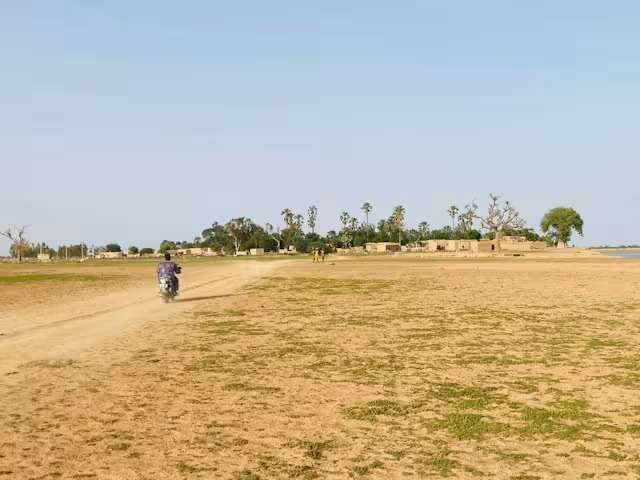
Photo by Kagou Dicko / Unsplash
Mali participates in the GEF-8 Sustainable Cities Integrated Program (SCIP) through its capital, Bamako, advancing integrated urban development in a context of rapid population growth and significant climate vulnerability. As one of West Africa’s fastest-growing urban centers, Bamako faces pressing challenges related to flooding, inadequate waste management, land degradation, and pressure on public infrastructure.
Through GEF-8 SCIP and the GPSC Global Knowledge Platform, the city is strengthening its land-use planning, expanding circular waste management systems, and piloting nature-based and decarbonized infrastructure solutions to reduce environmental and health risks. The program also aims to build local capacity for more resilient service delivery and investment-ready urban planning. Mali’s engagement contributes valuable insights to the GEF network on addressing urban resilience and sustainability in climate-stressed, rapidly evolving metropolitan environments.
UNDP serves as the Implementing Agency. The Executing Agency is the General Directorate of Local Authorities.
The project will focus on transforming Bamako into a model of sustainable urban development. It will address systemic challenges, including inefficient transport, poor air quality, and urban sprawl, by integrating low-carbon and nature-based solutions into urban planning. Key components include developing an integrated master plan for the city that incorporates climate resilience and green spaces, decarbonizing the transport sector through the promotion of electric two- and three-wheelers, and establishing a green belt to curb uncontrolled urban expansion. Additionally, the project will enhance municipal finance and engage the private sector to ensure long-term sustainability. A robust monitoring and evaluation system will ensure the effectiveness of these interventions, while knowledge-sharing platforms will disseminate lessons learned for wider adoption.
Component 1 – Integrated Urban Governance, Planning, and Sustainable Finance
- Regulatory and institutional reform for climate- and risk-informed urban planning, including harmonization of land-use frameworks and environmental safeguards
- Strengthening of intersectoral governance and territorial coordination mechanisms for integrated urban development
- Development of financial instruments and territorial financing mechanisms to mobilize public and private investment for green urban infrastructure
- Integrated solid waste management strategy embedded within urban planning and municipal governance systems
- Capacity building for national and municipal authorities on sustainable urban finance and policy implementation
Component 2 – Low-Carbon and Sustainable Urban Mobility
- Operationalization of Bamako Sustainable Urban Mobility Plan, including regulatory reforms and investment prioritization
- Deployment of electric vehicle charging infrastructure and enabling framework for hybrid/electric fleet transition
- Development of PPP models and financing mechanisms for low-carbon transport investments
- Institutional strengthening of urban transport governance and capacity building for sustainable mobility planning
- Establishment of transport-related GHG accounting and air pollution monitoring systems aligned with IPCC standards
Component 3 – Green Belt Restoration and Nature-Based Urban Resilience
- Legal reinforcement, land tenure clarification, and governance structuring for Green Belt protection
- Restoration and sustainable management of classified forests and degraded peri-urban ecosystems
- Deployment of agroforestry, reforestation, and climate-resilient green infrastructure interventions
- Strengthening forest inventory, GIS digitization, and ecosystem monitoring systems (SIFOR platform)
- Mobilization of private-sector-led investments and PPP structures for Green Belt and NbS implementation
Component 4 – Knowledge Management, Gender Mainstreaming, and Partnerships
- Gender-responsive knowledge management system and communication strategy
- National and territorial capacity building and technical training programs
- Participation in Global Platform for Sustainable Cities and international knowledge exchange networks
- Development of formal partnerships and multi-stakeholder collaboration mechanisms
Component 5 – Monitoring, Evaluation, and Impact Tracking
- Integrated gender-sensitive M&E framework aligned with GEF and UNDP standards
- GHG accounting for transport and AFOLU sectors using EX-ACT and IPCC methodologies
- Monitoring of land restoration, investment leverage, and financial performance indicators
- Periodic reporting, audits, mid-term review, and terminal evaluation processes
- Development and adoption of a new, integrated urban master plan for Bamako, incorporating climate resilience, nature-based solutions, and green spaces.
- Significant reduction in CO2 emissions through the promotion of electric vehicles, particularly in the two- and three-wheeler transport sector.
- Expansion of green infrastructure and the establishment of a green belt around Bamako to limit urban sprawl and enhance biodiversity.
- Increased municipal capacity for financing and managing sustainable urban development through innovative fiscal models and private sector partnerships.
- Enhanced knowledge-sharing and regional collaboration, with lessons from Bamako’s transformation serving as a model for other cities in the region.
Total GEF Grant (USD)
5,333,333
Total Co-financing (USD)
35,500,000
World Bank Country Profile (Data Portal)
For broader socioeconomic and environmental context, consult the World Bank Country Data Profile. It provides up-to-date indicators on economic performance, social development, climate and environmental metrics, as well as an overview of World Bank operations and financing in the country. Access the country profile here.
GEF Country Profile
For information on Global Environment Facility engagement, see the GEF Country Profile. It presents an overview of GEF-funded projects, thematic areas of intervention, implementing partners, and country resource allocations, offering insight into environmental investment priorities and ongoing initiatives. Access the country profile here.
WOFI Country Profile
For additional insights on subnational public finance, see the OECD Subnational Government Finance Observatory (WOFI) Country Profile. It provides internationally comparable data on revenues, expenditures, investment, debt, and fiscal arrangements across levels of government, offering a useful reference on fiscal capacity and decentralization. Access the country profile here.
Theme