

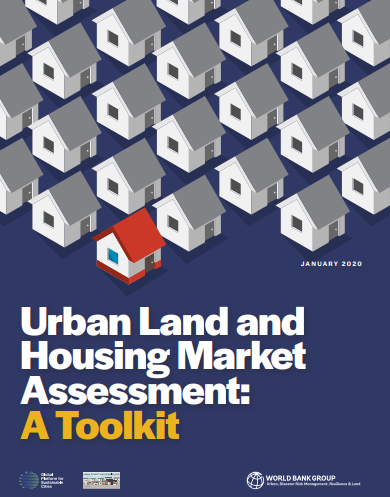
The Urban Land and Housing Market Assessment Toolkit aims to assist practitioners in undertaking a standard upstream diagnosis to inform policies and programs in the housing sector at the city level in developing countries, with a focus on the supply side. It is designed to balance the need for achieving a comprehensive assessment of a complex sector like housing and the political impetus to identify problems and take actions within a short timeframe. Toolkit builds on decades of research and practice in the land and housing sector, combining elements from the three existing types of assessments, tapping into new technology while striving for practicality and ease in application. This report resembles a scaled-back version of the UN-Habitat Housing Profile and draws on recent World Bank Group experience.
It is envisioned as a living document that incorporates learning and continued refinement. The toolkit has three parts. Part A is focused on indicators to assess problems in the city’s housing and land value chain, and current housing and related policies. Part B is focused on assessing the different factors restricting housing production and ranking them in importance. Part C prioritizes potential interventions by assessing which government actors are the most amenable to engagement and have the greatest capacity for action and/ or reform.