

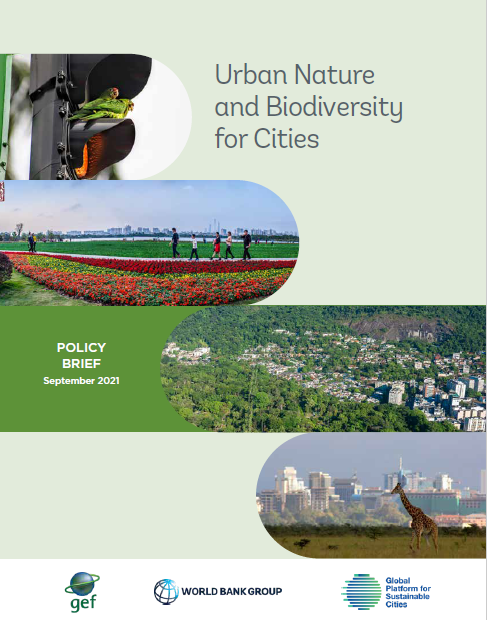
Urban Nature and Biodiversity for Cities. Policy Brief

21 September 2021

One important way for urban leaders to rise to today’s challenges is to bring biodiversity and nature into urban design through urban ecological planning. Such planning recognizes that cities depend on biodiversity and that biodiversity depends on cities. Ecological planning not only illuminates the linkages between urbanization and biodiversity, but also helps integrate this understanding into urban planning, strategy, and investment. 

We have the knowledge, data, tools, and approaches to direct investment in nature to solve many different types of urban problems. Using these approaches today will help cities of the future become more sustainable, livable, resilient, and equitable.


Authors

Anne D. Guerry
Co-Executive Director of the Natural Capital Alliance,
Eric Lonsdorf
Professor,
Gretchen C. Daily
Faculty Director, Natural Capital Alliance,
Xueman Wang
Senior Urban Specialist, World Bank
Yuna Chun
Urban Analyst, World Bank

Partners

Theme

Downloads

Download
Related content
View all

Nature

Nature-based Solutions to Build Climate Resilience in Informal Areas

This strategy paper draws from existing research and practical project experience applying nature-based solutions (NBS) for adaptation and building climate resilience in informal areas to better
Knowledge Product

Learn more

Nature

Piloting Nature-based Solutions for Urban Cooling

Reducing excess urban heat and protecting populations from extreme temperatures is one of the 21st century’s key resilience and sustainability challenges. As the planet warms, cities are increasingly
Knowledge Product

Learn more

Nature

Integrated Programming in the Global Environment Facility: Learning from the GEF-6 IAP Programs

This report summarizes key findings from a learning exercise on the GEF-6 Integrated Approach Pilot (IAP) programs, which were launched in 2014 as a new approach to tackling major drivers of
Knowledge Product

Learn more