

Assessing the Benefits and Costs of Nature-Based Solutions for Climate Resilience: A Guideline for Project Developers
19 SEPTEMBER 2025 /Blog

Fishermen in Indonesia know it from experience: the country’s mangroves are not just stabilizing an eroding coastline and preventing coastal flooding; they are also important carbon sinks, supporting marine biodiversity and local fisheries. The erosion of coastlines and a sharp decline in annual income for fishing households -- 5 to 10 times the rate of mangrove loss-- are dire consequences when these coastal forests disappear. As climate change intensifies and ecosystems are degraded, countries like Indonesia are facing increasingly complex challenges such as extreme temperatures and flooding. Nature-based Solutions (NBS) for climate resilience, such as mangroves, urban green spaces, and inland wetlands, offer economical strategies to mitigate these risks, while also sustaining biodiversity and other important ecosystem services.
This report, Assessing the Benefits and Costs of Nature-Based Solutions for Climate Resilience: A Guideline for Project Developers, aims to promote the adoption NBS for climate resilience by providing actionable valuation approaches that can be applied at the project level to inform investments. For example, in Sri Lanka, the economic case was made for wetland conservation in Colombo city, showing that the benefits of flood management and recreation outweigh the opportunity cost of land development. In Indonesia, a national-level cost-benefit analysis revealed the economic viability of mangrove conservation and restoration and helped identify priority areas for a $400 million USD investment , offering coastal protection and ecosystem services supporting the livelihoods of local communities.
What makes a good assessment? The guideline helps value the benefits of NBS for reducing disaster risk, as well as other benefits such as food production, tourism, recreation, biodiversity, health, and water quality. While the valuation approach might differ from project to project, six analytical steps and four guiding principles are proposed for all assessments:
- Value both risk reduction and other benefits. NBS are multi-benefit and therefore multistakeholder approaches. The other benefits such as biodiversity, climate regulation, and ecosystem services supporting local livelihoods are a crucial part of their value proposition.
- Engage stakeholders to scope locally relevant benefits of NBS. It is critical to consult and engage stakeholders to identify the relevant benefits to consider in project identification to ensure community buy-in and engagement.
- Address uncertainty. Uncertainties driven by both climate and socioeconomic conditions play an important role in the assessment of the benefits and costs of NBS.
- NBS benefits assessment and cost assessment should be an integral part of investment projects, to engage stakeholders, to assess economic viability of investments and to evaluate impact of the NBS.
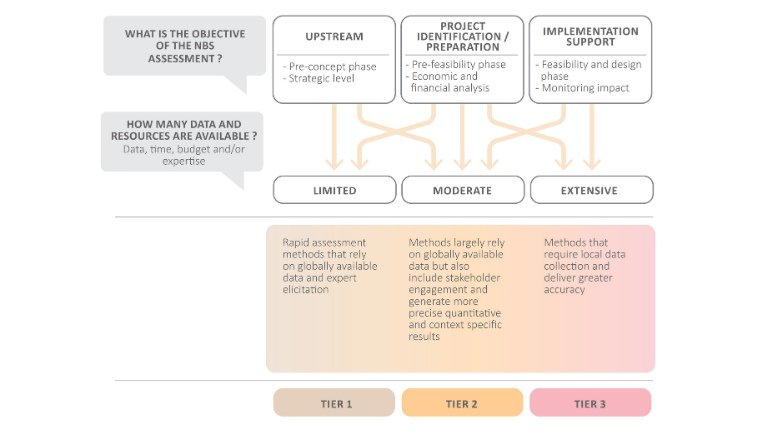
To establish the right method to use for a decision context, the guideline proposes a tiered approach This approach guides research design based on the project phase, available time, data, and resource constraints. The tiers the best method for the project, while remaining flexible to accommodate different priorities. Higher tier methods provide more detailed and precise outputs, but also require more input data, time, resources, and expertise.