

Urban Nature Program
19 SEPTEMBER 2025 /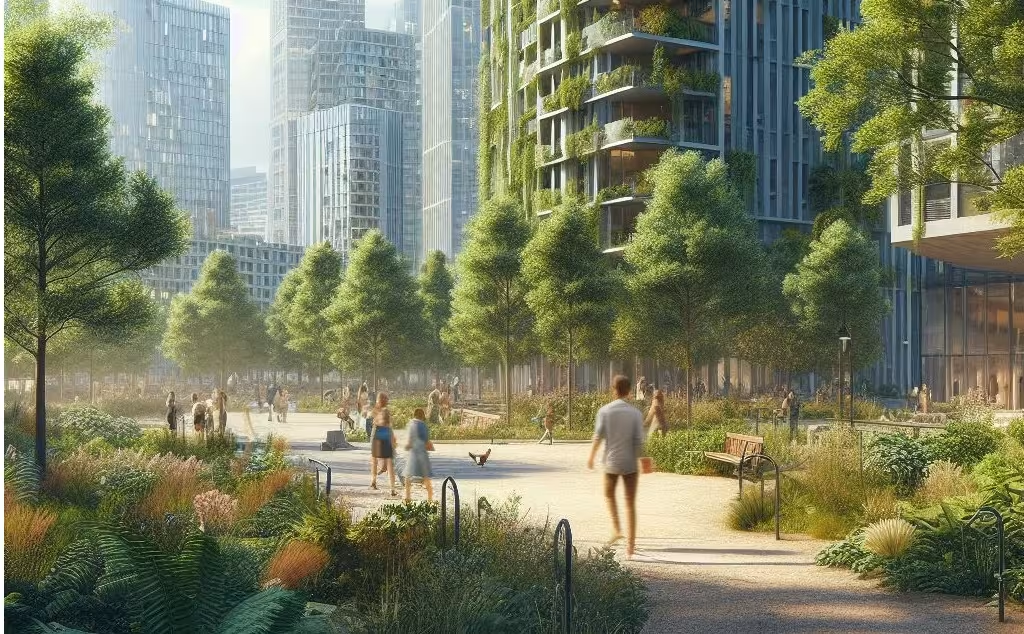
The Urban Nature Program aims at connecting and supporting cities and sub-national governments (together referred to as “cities” in this document) to implement and scale up their commitment and action plans to deliver integrated solutions to climate change and biodiversity loss.
In recent years, a movement to become nature-positive in addition to net zero has emerged, emphasizing both the preservation and enhancement of ecosystems.[1] To achieve ‘nature-positive urban development’ we need to halt and reverse nature loss from the 2020 baseline, through increasing the health, abundance, diversity and resilience of species, populations and ecosystems so that by 2030 nature is visibly and measurably on the path of recovery; with a view to full recovery by 2050, where thriving ecosystems and nature-based solutions continue to support future generations, the diversity of life and play a critical role in halting runaway climate change.[2]
The Program will bring together a group of Lighthouse Cities in both developing and developed countries and leverage various existing initiatives, including the World Bank Global Platform for Sustainable Cities’ (GPSC) Cities4Biodiversity (C4B), ICLEI’s CitiesWithNature, UNEP’s Decade on Ecosystem Restoration and Generation Restoration Project, IUCN Urban Alliance, EU’s mission on Climate-Neutral and Smart Cities, and WRI’s Cities4Forest and the Climate Resilience Practice. Additionally, collaboration with the private sector, including IFC, WBCSD, and WEF, will be sought to explore innovative financing instruments and mainstream nature into investment.
The Program will be organized into three work streams:
- Upstream Policy Support: coordination and exchange of information of various initiatives, supporting cities for policy engagement, peer-to-peer learning, and engaging global expertise.
- Midstream Project Preparation Support: targeted and bankable project preparation support by engaging a network of international and domestic financial institutions and private sector investors.
- Downstream Investment: supporting MDBs and financial institutions to mobilize investment in nature-positive development.
A group of Lighthouse Cities from developed and developing countries will be invited to join the Program and lead the efforts provided through the three streams. A Mayors’ Leadership Forum will also be established for cities to demonstrate global leadership in contributing to the Kunming-Montreal Global Biodiversity Framework (GBF) targets, the UN Decade on Ecosystem Restoration, and CBD Decision 15/12 on Engagement with subnational governments, cities and other local authorities to enhance implementation of the GBF and its Plan of Action on Subnational Governments, Cities, and Other Local Authorities for Biodiversity (2023–2030).
The Program will be co-led by the World Bank through its Global Platform for Sustainable Cities (supported by the GEF) and ICLEI, with the partnership of UNEP, WRI, IUCN, C40, WBCSD, and multilateral/regional development banks and agencies, and in collaboration with the European Commission.
The Program modality will be further discussed in a working group meeting during the IUCN Leaders’ Forum on October 11-13, 2023, and officially launched at COP28 in December 2023.