

Costa Rica Aims to Transition Towards an Urban Green Economy with GEF Support
19 SEPTEMBER 2025 /Blog
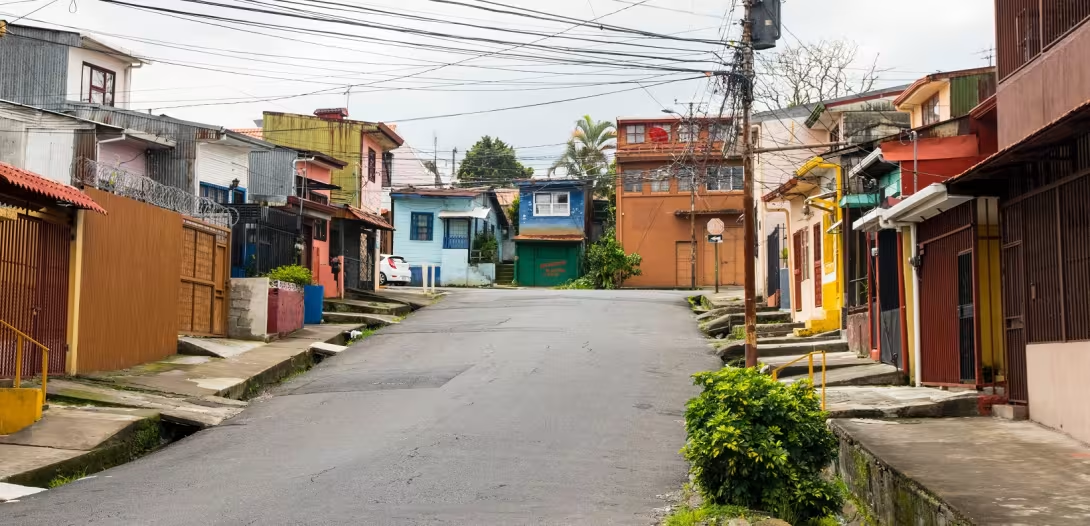
Greening Costa Rica’s cities with more trees, promoting circular economy business models, fostering legal and institutional reforms, and promoting urban mobility infrastructure focused on the health of people and ecosystems are among the goals of a new GEF-supported project launched today. The initiative will invest $10.3 million over five years. It will be led by Costa Rica’s Ministry of Environment and Energy and implemented by the United Nations Development Program, in partnership with the Organization for Tropical Studies.
The objective of the project is to support decarbonization in the Greater Metropolitan Area – which comprises the provinces of San José, Alajuela, Cartago, and Heredia – through sustainable integrated urban planning. Its work will include efforts to reform obsolete laws, build urban mobility infrastructure, and restore more than 2,000 hectares of forest and green spaces in the urban center. This will occur in coordination with local governments in the area and entities with experience in the field of sustainable urban development and circular economy promotion. The project is part of the GEF’s Sustainable Cities Program – UrbanShift, which aims to transform cities through integrated urban planning and investment in innovative sustainability solutions.
The project launch announcement was made during a virtual event with the participation of Costa Rica’s Minister of Environment and Energy Andrea Meza Murillo, Housing and Human Settlements Minister Irene Campos, Minister of Finance Elian Villegas, as well as Global Environment Facility CEO and Chairperson Carlos Manuel Rodríguez, the UNDP representative in Costa Rica José Vicente Troya Rodríguez, and the Alajuelita Mayor Modesto Alpízar.
The President of the Republic, Carlos Alvarado Quesada, has indicated that Costa Rica is betting on the construction of the Metropolitan Electric Train as one of the main ways to decarbonize and transform a public transportation system that is currently inefficient. This project will produce wide benefits through specific actions to improve the urban landscape and mobility in the 20 cantons of the Greater Metropolitan Area located along the electric train track and its surroundings.
In this context, Minister of Environment and Energy Andrea Meza Murillo explained that the new project "Transitioning to an urban green economy and delivering global environmental benefits" will make an additional difference with more than $1 million in investments for sustainable mobility, with bicycle lanes, shared use routes, pedestrian walkways with green areas and more. UNDP Resident Representative José Vicente Troya Rodríguez noted that "fossil fuels are choking humanity and have placed us in a danger zone we never imagined. If we want to survive on this planet, we must move towards a future based on renewable energies, with universal access, gender equality, and green jobs of the future. This project is a way forward in this direction."
"The approach of this project is extremely ambitious because it seeks to change the economy by decarbonizing the income base of an entire country. That is the level of ambition that the GEF is interested in seeing in the projects that countries propose. We are honored to share a vision with MINAE, OTS, and UNDP to accelerate sustainable cities and achieve net zero emissions by 2050," said Carlos Manuel Rodriguez, CEO and Chairperson of the GEF.
Sustainable mobility works will be coordinated with municipalities and entities with expertise in the field. At the end of the project, these solutions will include 8 km of bicycle lanes, 3 km of shared paths and pedestrian walkways, and 20 km of green sidewalks with improved access. Over the next 5 years, the project will restore urban ecosystems on a total of 2,000 hectares, achieving the reforestation of 1,000 trees per hectare. This will allow the direct capture of 24,000 tons of carbon dioxide equivalent in this period.
Circular economy approaches aim to maximize the use of all resources in the production chain, using biodegradable materials and reducing environmental impact. In the preparation phase of the GEF-supported project, it was concluded that Costa Rica has limited experience in promoting these forms of production or advancing them with regulation. The project will map existing circular economy initiatives, and invest in new business ventures with this approach, prioritizing the employment of women in areas such as waste management, and providing training in business management.
The transition to an urban green economy will require additional resources to support local government activities. The existing opportunities within Costa Rican legislation will be used to channel even more resources to sustainable urban solutions. In addition, the skills and knowledge of municipal governments will be strengthened in the Greater Metropolitan Area to generate new financial mechanisms for local sustainable development.
"Considering the environmental reality we face, it is our responsibility to generate climate and economic resilience, where cities and human settlements contribute to sustainable development. The initiatives that the Ministry of Housing and Human Settlements is promoting aim to generate the conditions for sustainable and resilient urban planning, land use, infrastructure and housing," said Minister of Housing and Human Settlements Irene Campos Gómez.
To learn more about UrbanShift, please visit: https://www.shiftcities.org/
Originally published here