

Once Southeast Asia’s Trading Hub, Melaka Strengthens Urban Planning for a Sustainable Future in Malaysia
19 SEPTEMBER 2025 /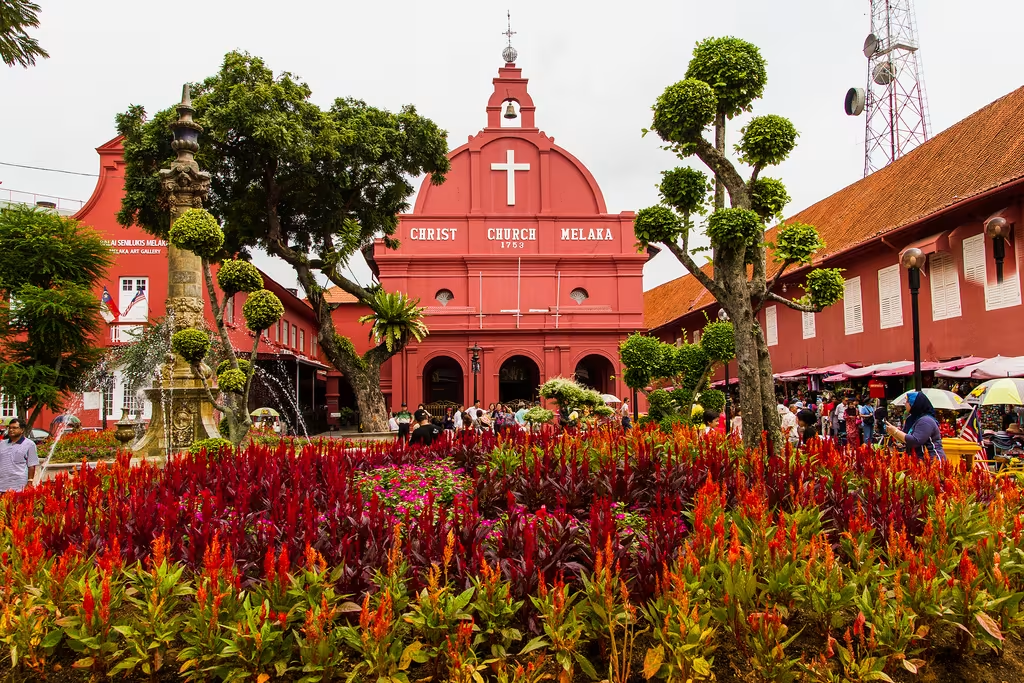
In the 15th century, few places in Southeast Asia rivalled Melaka as a trading hub – a strategic conduit for the bustling spice trade. As traders from the region settled in the area and contributed to a melting pot of cultures, Melaka transformed into a hub known for its diversity, resilience, and innovation.
Melaka retains its reputation for openness, and is extending it beyond cultural heritage into development solutions. The Malaysian state is host to the country’s first solar farm and a large new port, and the Melaka City’s riverfront is being transformed into a picturesque tourist attraction.
The city’s recent launch of the first Sustainable City Development project in Malaysia enhances this transformation.
In addition to being the first of its kind in Malaysia, this is also the first city-led project for the Global Partnership for Sustainable Cities, or GPSC, which strives to integrate sustainability into urban planning.
Led by the World Bank and supported by the Global Environment Facility (GEF), the GPSC facilitates cities with access to cutting-edge tools, knowledge support, and expertise in integrated approaches to sustainable urban planning and financing. Another key partner and the implementing agency of the project is the United Nations for Industrial Development Organization (UNIDO), which is extending its local operational expertise to help Malaysia build a foundation for data-driven integrated planning.
Melaka’s leadership is important. Its bold venture translates into more than US$60 million in investments over the next five years – investments that will support the adoption of low-carbon technologies and integrated approaches to city planning. Included in the plans is a smart grid system to show that solar-based renewable energy complemented with ICT-based systems can better support two-way communication between electricity providers and users.
Also being prepared is a blueprint for sustainable development for the state of Melaka and the national government, as part of the country’s efforts to create compact, connected, and sustainable cities.
Melaka also plans to establish the Malaysian International Center for Sustainable Cities—and link it to the GPSC—to showcase results, disseminate lessons learnt from the project, and connect local project proposals to global financing mechanisms. The link to the GPSC is strategic. Managed out of the World Bank Hub for Infrastructure and Urban Development in Singapore, the GPSC currently covers 27 cities across 11 pilot countries and hopes to reach many more through the sharing of data, experiences, ideas, and solutions related to urban challenges.
The city is proud of being the vanguard for such initiatives. In his speech at the conference, Melaka’s Chief Minister – the equivalent of a Governor – Datuk Seri Utama Ir Idris Haron reminded the audience, “You must make sure Melaka be the first. If not, don’t do it in Melaka.”
Going forward, the Melaka project will further strengthen the partnership with the World Bank and UNIDO, as the project team works closely with local stakeholders to provide technical assistance for preparing bankable projects, linking them to financing, as well as giving access to technology.
The diversity of initiatives amounts to, quite simply, a determination to achieving results. Naoko Ishii, CEO and Chairperson of the GEF, describes Melaka as being “the forefront of a global effort to transform the future of cities.”
Melaka is one of the smallest states in Malaysia. Yet its well-kept spirit of openness may help it become the region’s forerunner for integrated and sustainable urban planning.