

The Wetland Advantage: Nature-Based Solutions Power Rwanda’s Urban Future
13 FEBRUARY 2026 /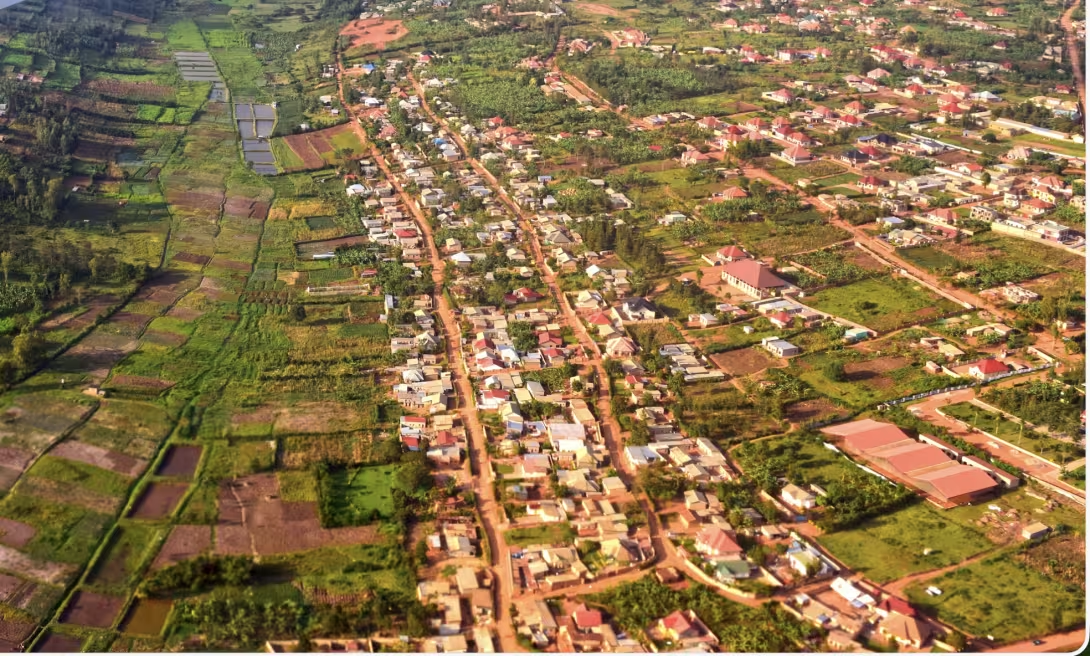
Highlights
- Kigali is bringing nearly 500 hectares of urban wetlands back to life—the largest city-wide urban wetland rehabilitation in Africa and one of the largest in the world. This “living infrastructure” has new spaces for tourism, education and recreation, improves water quality and biodiversity, and enhances the usability of adjacent land while bolstering the city’s frontline defense against floods.
- Through RUDPII, 220,500 people in flood-prone neighborhoods will directly benefit from reduced flooding and a healthier environment. That’s roughly a sixth of Kigali’s population gaining safety and quality-of-life improvements.
- Five Wetland Ecosystem Parks will draw over 1.5 million annual visits by 2036, create 7,500 jobs (nearly half filled by women), and result in $45-90 million in avoided flood damages, linking recreation, research, and nature-based tourism to community benefits.
On a rainy afternoon in Kigali, water used to surge through hilltop neighborhoods, rushing toward the city’s valleys and flooding roads, businesses and homes. Years of encroachment spurred by the city’s rapid growth, from less than a half million residents to more than 1.3 million over the span of a single generation, had shrunk the city’s natural sponge: wetlands dropped from 100 square kilometers in 2013 to 72 by 2019, weakening flood protection and water purification just as urbanization accelerated. Today, under the Second Rwanda Urban Development Project (RUDP II), Kigali is taking a different tack—restoring wetlands as infrastructure, public commons, and economic platforms at once.
When rapid urbanization led to rising flood risk, Kigali turned to nature
Rapid growth and scarce land drove both industrial developments and unplanned settlements into hazard-prone areas, while inadequate solid waste and wastewater management raised flood and pollution risks. The World Bank-supported RUDP II is implemented in partnership with the Global Environment Facility, Nordic Development Fund, Climate Investment Funds, Rwanda Green Fund, Germany’s KfW and the Government of Denmark, and includes high-quality natural capital data and analysis from the Global Program on Sustainability. It integrates wetland rehabilitation with targeted green-grey works along flood hotspots and settlements, and citywide tools like a stormwater master plan—shifting from reactive drainage to proactive landscape resilience.
The World Bank’s broader work on nature-based solutions has culminated in the creation of a working group that is driving investments throughout the city. Thanks to the leadership of Rwanda Environment Management Authority (REMA), the lead institution responsible for planning and implementation, what could have been discrete upgrades were instead strategically envisioned as an urban resilience initiative with nature-based solutions at its core. “These projects demonstrate that true urban resilience isn’t built with concrete alone—it is strengthened by restoring nature to the heart of our city. By rehabilitating Kigali’s five urban wetlands, we are not only reducing flood risks and protecting biodiversity, but also creating healthier, greener, and more livable spaces for our communities, today and for generations to come,” said Juliet Kabera, Director General of REMA.
These projects demonstrate that true urban resilience isn’t built with concrete alone—it is strengthened by restoring nature to the heart of our city. By rehabilitating Kigali’s five urban wetlands, we are not only reducing flood risks and protecting biodiversity, but also creating healthier, greener, and more livable spaces for our communities, today and for generations to come.
The idea: five wetland ecosystem parks, one connected system

Before this project, flooding was a constant threat to our homes and livelihoods. Restoring the wetlands has changed that. Today, we are safer from floods, our environment is healthier, and we expect to gain new income opportunities through ecotourism and other activities that will take place in the wetlands once they open. This project is not just protecting nature—it is improving the lives of residents across Kigali.
Frodouard Minani (a wetlands restoration project beneficiary)
People and prosperity: Four everyday gains for Kigali residents

For Kigali and its entrepreneurs, restoration pays
The net present value of avoided flood damages under RUDP II is estimated at US$45–90 million, with knock-on benefits across transport, downstream agriculture, and urban services. The management strategy envisions wetlands as platforms for inclusive enterprise:
- Jobs: A pathway to around 7,500 full-time equivalent jobs—nearly half filled by women—across restoration, guiding, research, events, maintenance, and recreation services.
- Small and Medium Enterprises: Targeted support to 50 SMEs per year by 2031 and 100 by 2036, from eco-retail and equipment rentals to training hubs and food and beverage concessions.
- Revenue-sharing partnerships: Transparent concessions with private and community operators will sustain maintenance and reinvestment, anchored by a Wetland Business Development Unit.
Governance built to last
The long-term management strategy envisions a Wetland Ecosystem Parks Committee made up of government agencies overseeing environment, development, finance and economic planning, with the City of Kigali leading the strategy. A proposed single Wetland Management Company would run daily operations across all sites, supported by a multi-stakeholder forum and scientific advisory group. This model formalizes the backbone of nature-based infrastructure: maintenance, safety, partnerships, programming, and monitoring.
Advancing knowledge for urban nature-based solutions
RUDP II is a World Bank platform project: wetlands restoration is paired with a Stormwater Management Master Plan, LiDAR mapping, flood hotspot works, and a greenhouse gas accounting framework for Kigali. Regionally, Kigali’s approach is highlighted as an integrated climate action case in the Next Generation Africa Climate Business Plan. The project’s tools and results—citywide planning, hydrological data, and nature-based solutions design integration—are regionally significant for the way they are informing work in Rwanda’s secondary cities and globally relevant through their contribution to the Bank’s growing knowledge base.
A new urban vernacular
Kigali’s Wetland Ecosystem Parks signal a simple idea made tangible: when cities grow by working with nature, they become safer, cleaner, and more inclusive. In Kigali, trails and boardwalks invite families and visitors; research hubs and training spaces grow skills and enterprises; recreation and tourism bring new opportunities for small businesses; restored marsh and lakes blunt the peaks of storms. REMA Director General Kabera summed it up this way, “Kigali’s wetland renaissance is more than an environmental initiative; it represents a transformative vision of a modern, resilient African city—one that restores ecological balance, safeguards biodiversity, and enhances natural habitats while fostering sustainable urban growth.” In this fast-growing urban setting, wetlands are no longer on the edge of the map; they are the blue-green heart of a resilient city.
Kigali’s wetland renaissance is more than an environmental initiative; it represents a transformative vision of a modern, resilient African city.