

PANORAMA: GPSC expands to promote Sustainable Urban Development and Resilience
19 SEPTEMBER 2025 /Blog
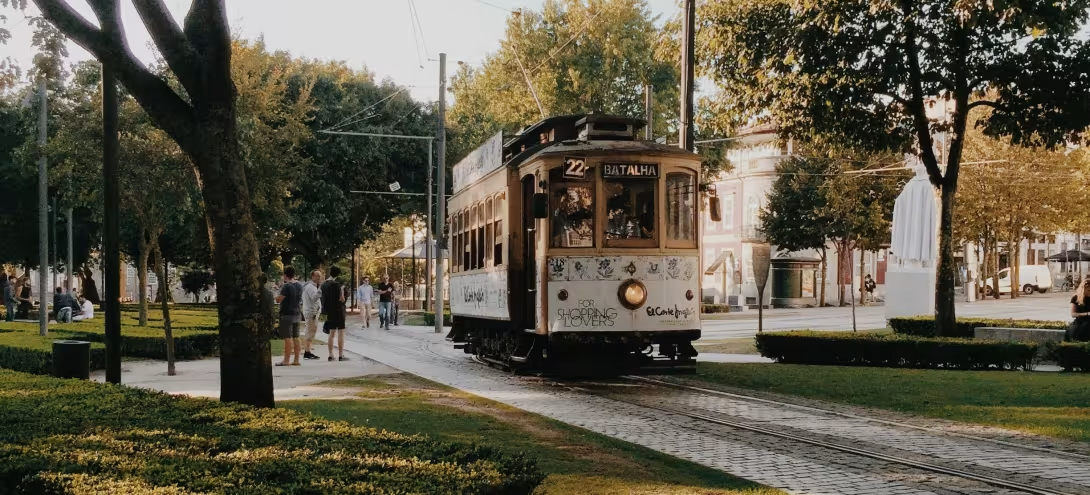
On the occasion of World Cities Day 2020, the World Bank and the International Union for Conservation of Nature (IUCN) are launching the Sustainable Urban Development and Resilience community on the PANORAMA platform.
PANORAMA – Solutions for a Healthy Planet is a partnership initiative to document and promote examples of inspiring, replicable solutions across a range of conservation and sustainable development topics, enabling cross-sectoral learning and inspiration. The solutions are shared through interlinked thematic communities, of which there are now seven.
Through the new urban thematic community, the World Bank, IUCN and their partners intend to showcase pragmatic solutions to pressing urban challenges, drawing on research and project experience from across the world. Their aim is to inform and inspire action to strengthen the resilience and sustainability of cities, where the future of humanity is said to lie.
All PANORAMA solutions are carefully reviewed and curated. An initial batch of urban solutions has already been published offering a rich diversity of best practices. They include, establishing ‘water funds’ to restore catchments around drought-stricken cities, capturing land value uplift to finance sustainable transport infrastructure, and retrofitting schools to ensure earthquake-readiness. Yet others entail converting municipal solid waste into biogas to power industry, creating pollinator habitats on high-rise rooftops, and organising downtown bioblitzes with scores of citizen scientists.
Urban practitioners are encouraged to use the PANORAMA platform to share and reflect on their work, source insights and ideas, and learn from each other. As a multi-partner platform with a global userbase, PANORAMA can help to bring international recognition to the efforts of individuals and organisations that are championing solutions. It can also shine a spotlight on particular issues with which they are contending.
The Sustainable Urban Development and Resilience community underscores the growing importance of urbanisation vis-à-vis conservation and development. Despite occupying just 2-3% of the world’s land surface, cities are home to over half of humanity, accounting for approximately 75% of natural resource consumption and 70% of CO2 emissions. They are also heavily exposed to climate risks. Yet as centres of political and financial capital, and as hubs of innovation, cities are uniquely placed to drive transformative change. They are central to human progress. This is recognised through Sustainable Development Goal 11 to “Make cities and human settlements inclusive, safe, resilient and sustainable.”
The publication of solutions on the PANORAMA platform is complemented by peer exchange events, communications products, and various other mechanisms. To provide a closer look at the platform including the initial set of solutions, the coordinating partners will organise an introductory webinar in the near future.
Originally published here