

From Individual Projects to Systems Change: Advancing Circular Construction in Cities
11 NOVEMBER 2026 /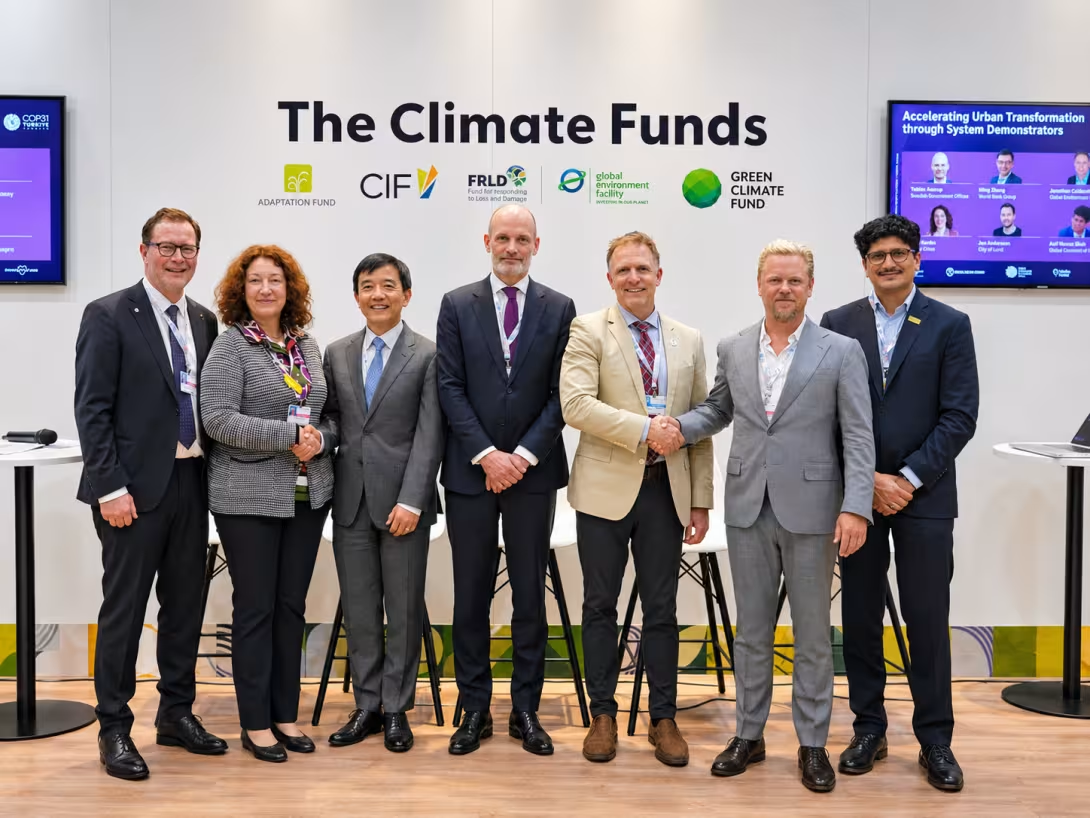
At COP31, cities and international partners explored how system demonstrators can connect urban planning, policy, investment, and industry to accelerate sustainable urban transformation.
Cities have significant potential to shape how buildings are designed, constructed, used, and eventually dismantled. Through urban planning, regulation, public procurement, and infrastructure investment, local governments can influence demand for sustainable building materials and support more circular construction practices. Yet these opportunities are often addressed through separate projects, institutions, and financing mechanisms, limiting their potential for broader transformation.
At COP31 in Antalya, Türkiye, on November 11, 2026, representatives from the Global Platform for Sustainable Cities (GPSC), the Global Environment Facility (GEF), Sweden's Viable Cities, the Viability Fund for Cities, and participating cities came together to explore how system demonstrators can help overcome these challenges.
Connecting Solutions Across Urban Systems
Developed by Viable Cities with Swedish and international partners, system demonstrators bring together coordinated interventions within a defined urban area or system. Rather than focusing on individual projects, they connect policies, financing, technologies, business models, and stakeholders around shared objectives.
The approach has already been applied to different urban challenges. In Lund, Sweden, the CoAction Lund initiative brings together 36 organizations to address interconnected energy and mobility challenges. In Bristol, United Kingdom, the Thriving Places initiative explores how aggregating small brownfield sites can help make affordable, zero-carbon housing development viable. In Bogotá, Colombia, the Green Routes initiative uses data sharing and coordinated action to improve urban freight planning.
These experiences illustrate how cities can bring together different actors and interventions to address complex challenges and create conditions for solutions to be replicated and scaled.
Exploring New Applications for Circular Construction
Building on these experiences, GPSC, with GEF support, and Sweden's Viable Cities and the Viability Fund for Cities are exploring a collaborative approach to applying system demonstrators to circular construction and building materials.
The proposed collaboration would examine how cities can combine planning, regulation, procurement, industry engagement, and financing to reduce construction waste, promote material reuse, and stimulate demand for low-carbon building solutions.
The next phase will focus on jointly developing the approach and exploring initial city applications during 2027, with the aim of generating practical lessons that could inform future sustainable urban development initiatives and wider replication.
For more information