

How innovative revenues for infrastructure can fundamentally reshape infrastructure funding
19 SEPTEMBER 2025 /

CVC is not limited to mass transit, it can also be applied to a variety of infrastructure from tourism and energy to telecommunications. For example, in wastewater treatment, CVC opportunities may include selling biogas for electricity, recovered phosphorous and nitrogen for fertilizers, or biosolids for biochar production or as compost for agriculture.
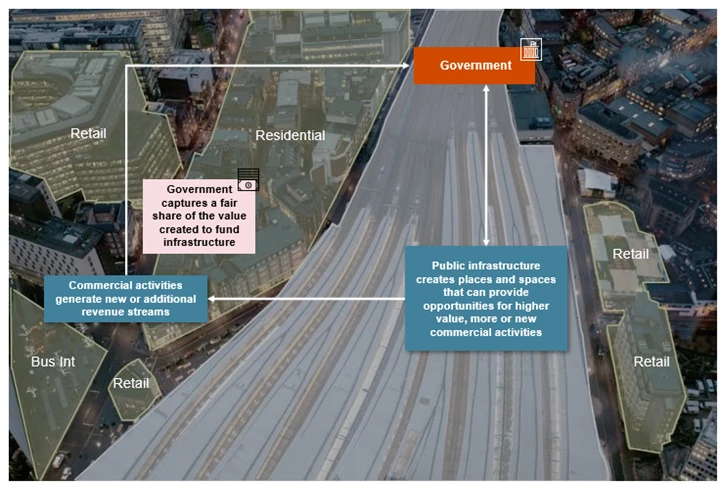
In urban transit development projects, CVC can be used to enhance infrastructure funding including locating retail and residential areas at or near the transit hub. For example, in India, residential and commercial properties have been developed around the Hyderabad outer ring road, enhancing its value by providing more opportunities for CVC.
Here’s an illustration of how CVC works in an urban transit development project:
If you happen to visit Tengeh Reservoir in Singapore, you may also find that the reservoir is used for a floating solar farm. It was leased out by the Singaporean government in 2021 for a 60 MW floating solar farm that supplies green energy to water treatment plants. The project optimizes urban space in Singapore (a rare and expensive commodity) on an otherwise unused water body to generate commercially viable revenues as well as delivering sustainable development.
The benefits of implementing CVC
Other benefits of CVC in infrastructure projects may include:
- Complements core services by enhancing the demand for infrastructure
- Increases levels of service for users and other beneficiaries when CVC is an integrated solution
- When correctly implemented, CVC is seamless and does not complicate core services
- Can increase economic growth, job creation, community development, and conservation of natural resources
Further resources on CVC
To better guide countries and interested stakeholders in assessing opportunities for CVC, the World Bank has developed a set of guidelines with assistance from PwC that aim to provide a framework to implement CVC opportunities. They encourage governments and project owners to be creative and develop solutions suitable to each country and project context. Intended to be aspirational and operational rather than detailed and exhaustive, the guidelines are relevant to those looking for alternative ways to increase public infrastructure funding or build a better business case for an infrastructure project.
The guidelines and further resources can be found here:
- The Guidelines for applying Commercial Value Capture (CVC) in infrastructure projects
- Additional resources to practitioners to apply CVC including worked examples and 100+ case studies
- Guidelines on Innovative Revenues for Infrastructure (IRI) – Section Overview
Disclaimer: The content of this blog does not necessarily reflect the views of the World Bank Group, its Board of Executive Directors, staff, or the governments it represents. The World Bank Group does not guarantee the accuracy of the data, findings, or analysis in this post.
Related Posts
Why access to land is crucial to foster investments in sustainable infrastructure
A deep dive into how city governments can meet the infrastructure demands of their citizens
The human drive to look "cool" and make money: Incentivizing climate action
A private-sector role in managing land administration? We did our homework