

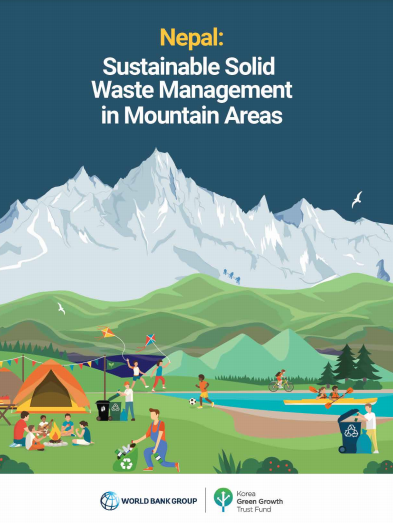
Nepal conjures up images of the Himalayas, climbing expeditions, tranquility in nature, and adventure holidays, making the country one of the most sought-after destinations for nature-based tourism. Ecologically sensitive areas as well as mountainous regions face some similar challenges when it comes to solid waste management (SWM). This study recommends that solutions need to be steadily built on a framework in order to successfully and sustainably manage mountain waste. This report presents various recommendations and implementable actions that may be adopted in a phased manner in order to overcome SWM challenges faced in mountain areas. The presented recommendations to manage solid waste in mountain areas are generally aligned with the integrated SWM framework and are summarized in the report.
This study represents the first attempt of the World Bank to examine SWM issues in these unique, ecologically fragile areas that face concurrent challenges of high poverty and increasing pressures from tourism development. Chapter one gives introduction. Chapter two discusses the current landscape of the SWM sector in Nepal. In chapter three, the report investigates the current situation regarding SWM in the mountain areas of Nepal. Chapter four looks at the complexity of managing solid waste in mountain areas as well as the various challenges and opportunities that arise. Chapter five presents a framework or foundation on which solutions can be steadily built and presents recommendations and related implementable actions along a phased approach. In conclusion, chapter six briefly summarizes the role of the World Bank in the SWM sector and how it can provide support to clients to improve SWM services and practices in mountain areas in the South Asia region and elsewhere.