

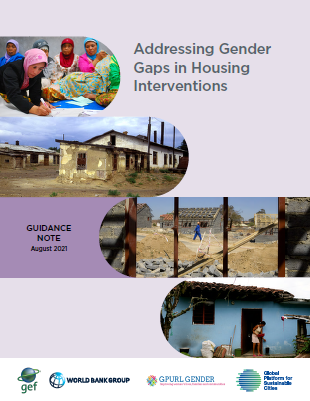
With more than half of the world’s population already living in cities, continued urbanization presents great opportunities as well as significant challenges. How cities respond to this growth will have a profound impact on the global environment. It is therefore essential not only to help cities grow in a way that promotes sustainability, but also to ensure that cities develop and respond to challenges in an inclusive way. This Guidance Note is intended to help World Bank task teams as well as city and national governments to consider the gendered impacts of various interventions in the housing sector. Ensuring that all citizens benefit regardless of their gender or gender identity is critical for successful housing interventions. Based on a literature review and consultations with World Bank staff, this Guidance Note identifies typical gender gaps in housing interventions, particularly the gaps associated with (i) access to affordable and adequate housing including ownership and tenure security, access to financing and smart subsidies, access to home improvements, rental housing and housing reconstruction, (ii) legal and socio-cultural aspects that affect housing, (iii) building materials and construction market development, and (iv) city planning and access to basic services.
Related content
View all
Inclusivity
Toward Developing a Mobility and Gender Index
Although the benefits of a gender-inclusive approach to mobility for transport decarbonization, access to jobs, and human capital advancement have been increasingly recognized globally, this topic has
Inclusivity
Women, Business and the Law 2021
Women, Business and the Law 2021 is the seventh in a series of annual studies measuring the laws and regulations that affect women’s economic opportunity in 190 economies. The project presents eight
Inclusivity
Gender Dimensions of the COVID-19 Pandemic (English)
Experiences from previous pandemics and large-scale shocks show that these crises often affect men and women differently. Specifically, the effectiveness of policy actions and the prevention of costly