


Partner Events
GEF6 China Sustainable Cities Integrated Approach Pilot Project Annual Workshop on Transit-Oriented Development (TOD)
16 July 2022
,
09:00
/
Online
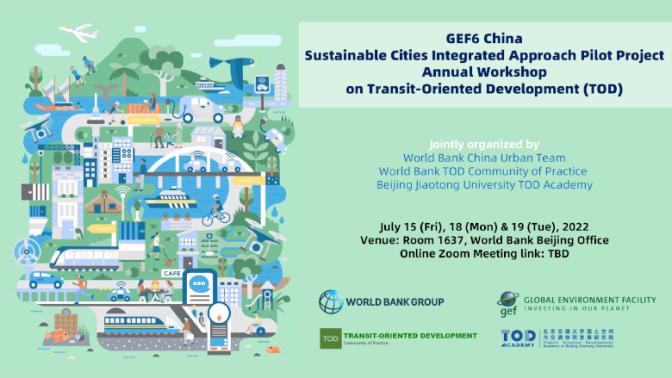
The World Bank implements the “Global Environment Facility 6--China Sustainable Cities Integrated Approach Pilot” Project (GEF6 China SCIAP)”, which aims to help Chinese cities incorporate transit-oriented development (TOD) principles into future urban policies and transit plans. The project consists of two components: 1) a national TOD platform implemented by China’s Ministry of Housing and Urban-Rural Development (MoHURD), and 2) TOD technical support and application at the city-, corridor-, and station levels implemented by seven cities, including Beijing, Tianjin, Shenzhen, Shijiazhuang, Nanchang, Ningbo, and Guiyang. The World Bank GEF6 China SCIAP Task Team organizes an annual workshop for MoHURD and participating cities to engage in technical and policy discussions.
This year’s conference is jointly hosted with World Bank TOD Community of Practice, as well as the TOD Academy of Beijing Jiaotong University. The workshop features three types of knowledge exchange activities: (a) International experts to share good practices relevant to China’s challenges in TOD, (b) MoHURD and participating cities to share technical outputs generated under this project and receive feedback from international and domestic experts, (c) Beijing Jiaotong University faculty to share latest research findings on TOD practices in China, including through field visits to inner-city and suburban sites in Beijing.