

Learning from past shocks to scale up disaster and climate resilience in Algeria
17 FEBRUARY 2026 /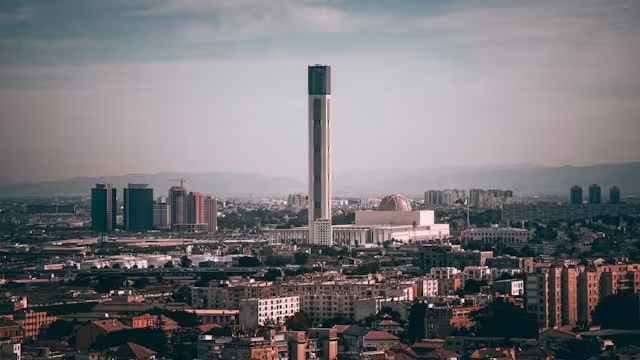
On October 10, 1980, a magnitude 7.1 earthquake destroyed the town of El Asnam (known today as Chlef) in Algeria, causing several thousands of casualties and leading to considerable economic losses. It was followed 3 hours later by a magnitude 6.3 aftershock, making it one of the largest and deadliest earthquakes ever recorded in Algeria. 23 years later, a 6.8 magnitude earthquake shook the country again and caused devastating damage in five provinces in the north-central region.
What would happen if a disaster of a similar magnitude hit the country today?
Unfortunately, disasters like these are far from rare in Algeria. Be it earthquakes, forest fires, or floods, Algeria has had its share of disasters over the years and has learned valuable lessons from them. The Algerian government estimates that annual spending over the past 15 years to respond to floods, earthquakes, and forest fires averages around USD 255 million (DZD 35,14 billion), with about 70% allocated to floods. Aware of the country’s growing disaster risks in the context of urbanization and climate change, the government has adopted numerous policies, regulations, and plans that demonstrate its commitment to better prepare for, manage, and mitigate the impacts of disasters. It is equally aware that the journey to disaster resilience is far from over and much remains to be done.
As such, the National Delegation for Major Risks (DNRM), which coordinates disaster risk management initiatives in Algeria, has joined efforts with the World Bank to evaluate the country’s disaster risk management system and to identify priority actions that could help boost the country’s resilience to future climate and disaster risks. Together, with support from the Global Facility for Disaster Reduction and Recovery (GFDRR), they conducted a study titled “Diagnostic on Climate and Disaster Risk Management in Algeria,” which provides the country disaster and climate risk profile, estimates the macro-economic impacts of disasters, and highlights the advancements and challenges of Algeria’s current disaster risk management efforts.
The report, developed from 2021 to 2023, represents the culmination of an extensive review of over 500 documents, a comprehensive multi-stakeholder consultation workshop conducted in 2021, and bilateral interviews held with the DNRM and all relevant stakeholders.
“The partnership between the World Bank and the National Delegation for Major Risks reflects our collective dedication to strengthening disaster risk reduction and resilience in Algeria. The recommendations delineated in the study will guide our decision-making and help us prioritize activities to safeguard our communities.”
Professor Hamid Afra, National Delegate for Major Risks.
The study forecasts that disaster losses could average around 0.7% of the country's GDP per year, nearly double the historical average. This increase is largely due to the potential of a devastating earthquake in urban areas, which are experiencing rapid population growth and are hence the most vulnerable. Climate change contributes to exacerbating the frequency and intensity of these shocks. The priority actions identified by the report include the need to improve inter-institutional coordination, deepen climate and disaster risk knowledge, promote investments to reduce the risks of floods and forest fires, strengthen early warning systems, and promote disaster risk financing and insurance.
With the support of the World Bank, the results and recommendations of the diagnostic were widely disseminated through a series of in-person events in Algeria to raise awareness on disaster risks and inform the dialogue on potential areas of collaboration at the national, regional, and international levels. On May 8th, 2023, a donor roundtable brought together participants from development partners and Algerian institutions to discuss the country’s disaster and climate challenges and explore potential avenues for government-donor collaboration. Later the same year, on December 12, an official launch event was organized in Algiers and attended by representatives from multiple Algerian government institutions. Following up on these events, a series of regional-level dissemination events reunited over 600 representatives from three Algerian wilayas in the east, west, and south-east of the country. The goal was to engage regional stakeholders and communities in the implementation of identified priority actions.
Scaling up resilience in Algeria is a mission possible. It requires all hands on deck to implement holistic, and integrated approaches. The lessons learned from past disasters and the priorities identified to tackle disaster and climate challenges offer a glimpse into the opportunities of a future where people in Algeria are safer and better prepared for natural hazards.