

Serbia
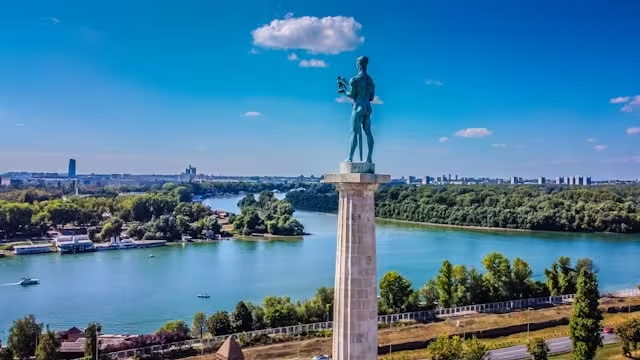
Photo by Imitrije Milenkovic / Unspash
Serbia participates in the GEF-8 Sustainable Cities Integrated Program (SCIP) advancing integrated approaches to low-carbon, resilient, and resource-efficient urban development. As Serbian cities continue to modernize and expand, the program supports national and local authorities in strengthening integrated urban planning, improving environmental management, and aligning infrastructure investments with climate and sustainability objectives.
Through engagement with the GPSC Global Knowledge Platform, Serbian cities are incorporating nature-based solutions, circular economy practices, and decarbonized urban systems into planning and investment processes. The initiative also promotes stronger institutional coordination, technical capacity building, and the development of finance-ready urban projects that can attract both public and private investment. Through its participation in GEF-8 SCIP, Serbia contributes to regional knowledge exchange while advancing practical solutions for sustainable urban transformation.
UNDP serves as the Implementing Agency. The Executing Agency is the Ministry of Environmental Protection.
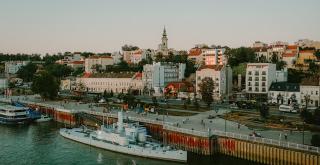
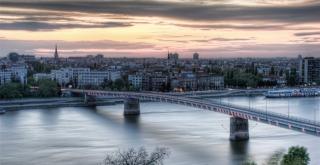
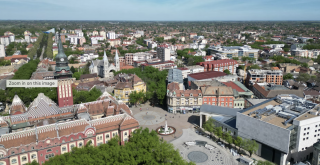
The project aims to support pilot interventions for the green, digital, and nature-positive transformation of three cities (Belgrade, Novi Sad, Zrenjanin) promoting sustainable urban development. The interventions will focus on: (i) promoting multi-sectoral resource and energy efficiency through decarbonization and circular business models; (ii) implementing integrated intra and inter-city spatial planning to enhance resilience and sustainability; and (iii) preserving natural capital and biodiversity. These efforts are expected to provide valuable experience by promoting a polycentric approach and developing tailored solutions, particularly for mid-size and smaller cities (Novi Sad and Zrenjanin).
Component 1 - Integrated Urban Planning and Policy Reform for Nature-Positive and Low-Carbon Cities
- Develop and operationalize integrated urban planning frameworks incorporating biodiversity conservation, climate mitigation, and land degradation neutrality objectives.
- Strengthen regulatory and institutional mechanisms for risk-informed land-use planning and ecosystem-sensitive spatial development.
- Integrate climate adaptation and resilience measures into municipal planning instruments and environmental governance systems.
- Establish cross-sector coordination platforms linking urban planning, environmental protection, transport, and infrastructure authorities.
- Strengthen municipal capacity for implementing sustainable urban development policies aligned with national climate and biodiversity commitments.
Component 2 – Nature-Based Solutions and Ecosystem Restoration in Urban and Peri-Urban Areas
- Restore wetlands and riparian ecosystems (including Carska Bara, Okanj Bara, Belo Blato, and Koviljsko-Petrovaradinski Rit) to improve biodiversity and climate resilience.
- Implement nature-based solutions for flood mitigation, water retention, and hydrological stabilization in urban and peri-urban landscapes.
- Improve management practices in protected and high conservation value landscapes to enhance ecosystem services.
- Develop monitoring systems for biodiversity, ecosystem condition, and land restoration performance.
- Promote community engagement and local stewardship in ecosystem restoration and conservation initiatives.
Component 3 – Decarbonization of Urban Systems and Sustainable Mobility
- Develop and implement sustainable urban mobility measures aimed at reducing GHG emissions and improving air quality.
- Promote energy efficiency interventions and low-carbon infrastructure upgrades in municipal systems.
- Strengthen local capacity for GHG accounting, climate mitigation planning, and emissions monitoring aligned with IPCC methodologies.
- Pilot low-carbon urban infrastructure solutions integrating mitigation and adaptation objectives.
- Mobilize public and private financing for scalable low-carbon and resilience-oriented investments.
Component 4 – Knowledge Management, Capacity Building, and Scaling
- Develop technical guidance, toolkits, and capacity-building programs for sustainable and nature-positive urban development.
- Facilitate participation in the Global Platform for Sustainable Cities (GPSC) and international knowledge exchange mechanisms.
- Strengthen monitoring and evaluation systems aligned with GEF Core Indicators and national reporting obligations.
- Promote replication and scaling of successful pilot interventions across additional municipalities.
- Improved urban infrastructure (e.g., water, waste, energy).
- Increased adoption of renewable energy and circular economy practices.
- Enhanced urban biodiversity and resilience through NbS.
- Strengthened local capacity for green urban governance and planning.
- Catalytic investments in sustainable development, leveraging public-private partnerships.
Total GEF Grant (USD)
7,065,602
Total co-financing (USD)
133,500,000
World Bank Country Profile (Data Portal)
For broader socioeconomic and environmental context, consult the World Bank Country Data Profile. It provides up-to-date indicators on economic performance, social development, climate and environmental metrics, as well as an overview of World Bank operations and financing in the country. Access the country profile here.
GEF Country Profile
For information on Global Environment Facility engagement, see the GEF Country Profile. It presents an overview of GEF-funded projects, thematic areas of intervention, implementing partners, and country resource allocations, offering insight into environmental investment priorities and ongoing initiatives. Access the country profile here.
WOFI Country Profile
For additional insights on subnational public finance, see the OECD Subnational Government Finance Observatory (WOFI) Country Profile. It provides internationally comparable data on revenues, expenditures, investment, debt, and fiscal arrangements across levels of government, offering a useful reference on fiscal capacity and decentralization. Access the country profile here.