

Gabon
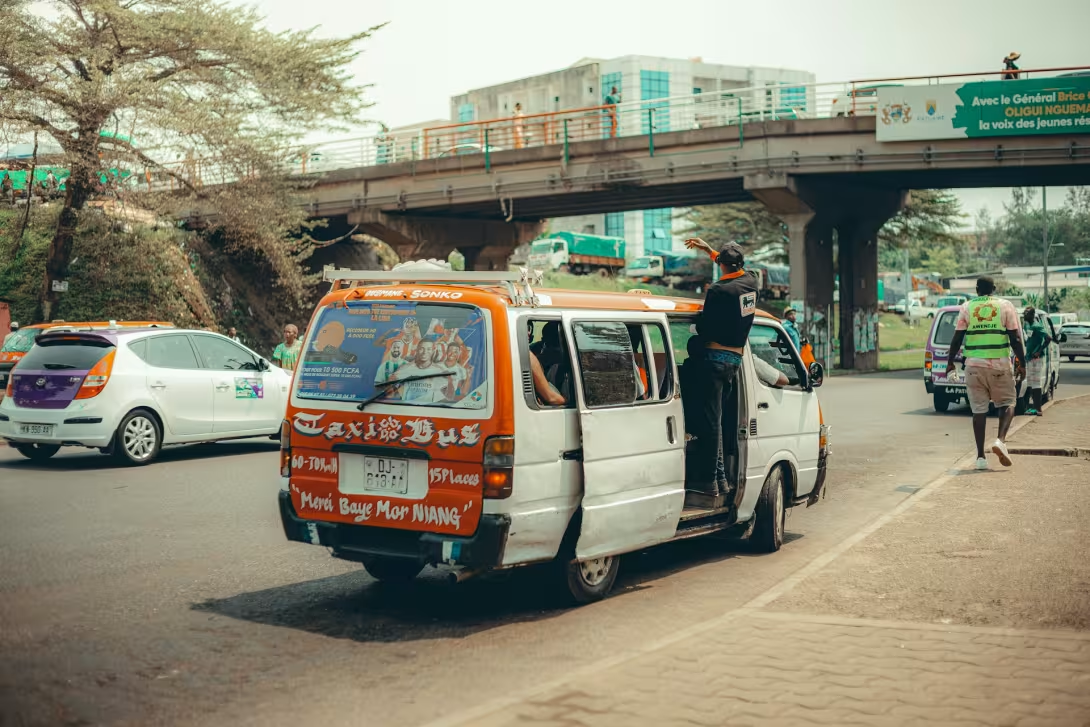
Photo by Jealife Pictures / Unsplash.
Gabon participates in the GEF-8 Sustainable Cities Integrated Program (SCIP) through the Grand Libreville metropolitan area, advancing integrated planning, climate resilience, and nature-positive urban development. As one of Africa’s most forested countries—with exceptional biodiversity and extensive coastal and riverine ecosystems—Gabon faces growing urban pressures linked to rapid demographic change, infrastructure gaps, and vulnerability to flooding and erosion.
Through GEF-8 SCIP and the GPSC Global Knowledge Platform, Grand Libreville is strengthening territorial planning, expanding green and blue infrastructure, restoring waterways and urban parks, and developing public-goods knowledge products to guide resilient growth. These efforts support the creation of investment-ready pipelines that integrate decarbonized infrastructure, circular economy measures, and nature-based solutions. Gabon’s leadership in environmental stewardship, combined with its emerging urban transformation agenda, brings important insights to the global GEF network—especially for cities seeking to balance expansion with ecological preservation.
UNDP serves as the Implementing Agency. The Executing Agency is the Ministry of Waters and Forests, the Sea, the Environment, responsible for the Climate Plan and the Land Use Plan.
The project aims to support pilot interventions for the green, inclusive, and nature-positive transformation of Grand Libreville, encompassing the communes of Libreville, Akanda, Owendo, and Ntoum, and adjacent national parks. The interventions will focus on: (i) advancing multi-sectoral urban resilience and decarbonization through sustainable urban planning, circular economy practices, and innovative investments; (ii) implementing integrated spatial planning to enhance sustainability, resilience, and equitable infrastructure access; and (iii) preserving natural capital and biodiversity through reforestation, green corridors, and nature-based solutions.
These efforts are expected to provide valuable insights by addressing the interconnected challenges of rapid urbanization, pollution, and climate vulnerability in fast-growing metropolitan areas. The project will demonstrate scalable solutions to balance environmental conservation, economic development, and social inclusion, contributing to Gabon’s sustainable development goals and serving as a model for replication in other cities across the country.
Component 1 – Urban Governance, Planning & Regulatory Frameworks
- Metropolitan governance strengthening for the Grand Libreville region (Libreville, Akanda, Owendo, Ntoum)
- Integrated spatial planning aligned with PNAT, SDAU, and Smart Code frameworks
- Regulatory reform for risk-informed land-use control and protection of high ecological value areas
- Development of urban financing mechanisms for sustainable and low-carbon infrastructure investments
- Institutional coordination mechanisms across metropolitan municipalities and environmental authorities
Component 2 – Urban Resilience & Ecosystem Management
- Urban climate vulnerability assessments addressing flooding, sea-level rise, and informal settlement exposure
- Nature-based solutions for flood mitigation and coastal resilience
- Reforestation and establishment of green corridors linking urban areas and adjacent national parks
- Urban ecosystem restoration and biodiversity conservation interventions
- Integration of ecosystem-based approaches into metropolitan resilience strategies
Component 3 – Sectoral Investments: Mobility, Buildings & Waste
- Low-carbon mobility interventions addressing car dependency and air pollution reduction
- Sustainable urban transport system improvements and modal shift strategies
- Energy-efficient and low-carbon building interventions
- Renewable energy integration into urban infrastructure systems
- Circular economy-based solid waste management reforms
- Plastic waste reduction and recycling value chain development
- Sustainable construction practices and materials efficiency promotion
Component 4 – Knowledge, Capacity Building & Communication
- Capacity building for municipal authorities on integrated urban resilience and decarbonization, and technical training on circular economy, biodiversity conservation, and low-carbon planning
- Behavior change communication campaigns promoting sustainable urban practices
- Knowledge management and replication framework for scalable urban transformation
Component 5 – Monitoring, Evaluation & Learning
- Integrated monitoring framework tracking resilience, decarbonization, and biodiversity indicators
- Adaptive management mechanisms based on performance data and evaluation findings
- Alignment of monitoring systems with national climate and biodiversity commitments
- Improved urban resilience and infrastructure (e.g., waste management, transport, renewable energy).
- Increased adoption of decarbonization and circular economy practices, including waste recycling and sustainable construction.
- Enhanced biodiversity and ecosystem restoration through reforestation, nature-based solutions, and green urban planning.
- Strengthened governance frameworks and local capacity for integrated urban planning and inclusive decision-making.
- Catalytic investments in sustainable development, leveraging public-private partnerships for scalable and replicable solutions.
- Improved health and well-being through better air quality, reduced pollution, and increased access to green spaces.
Total GEF Grant (USD)
9,039,038
Total Co-financing (USD)
127,800,000
World Bank Country Profile (Data Portal)
For broader socioeconomic and environmental context, consult the World Bank Country Data Profile. It provides up-to-date indicators on economic performance, social development, climate and environmental metrics, as well as an overview of World Bank operations and financing in the country. Access the country profile here.
GEF Country Profile
For information on Global Environment Facility engagement, see the GEF Country Profile. It presents an overview of GEF-funded projects, thematic areas of intervention, implementing partners, and country resource allocations, offering insight into environmental investment priorities and ongoing initiatives. Access the country profile here.