

Benin
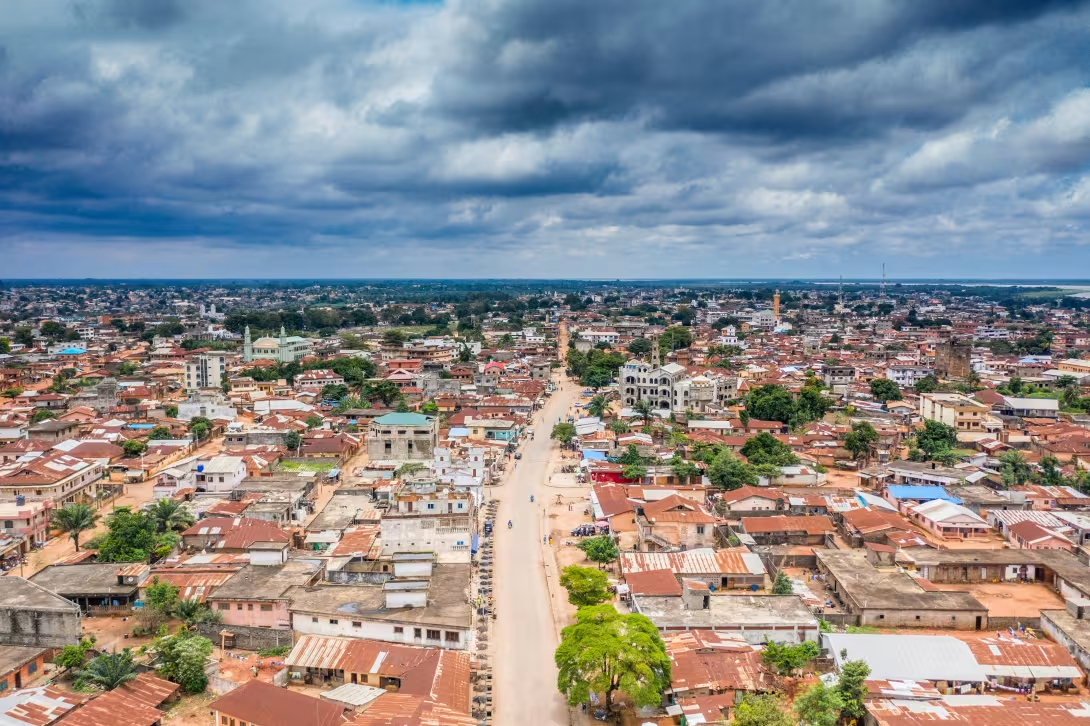
Benin participates in the GEF-8 Sustainable Cities Integrated Program (SCIP) through the Grand Nokoué metropolitan area, advancing integrated, climate-resilient, and nature-positive urban development. As the country’s largest urban region—encompassing Cotonou, Abomey-Calavi, Sèmè-Podji, and Porto-Novo—Grand Nokoué faces mounting pressures from rapid population growth, flooding, coastal erosion, informal settlement expansion, and stress on public services.
Through GEF-8 SCIP and the GPSC Global Knowledge Platform, Benin is strengthening metropolitan-scale planning, developing green and circular infrastructure solutions, improving mobility, and enhancing environmental governance. The program also supports the creation of bankable investment pipelines and promotes knowledge sharing across national and regional networks. Benin’s engagement brings valuable lessons to the GEF city community on how West African coastal metropolitan regions can balance growth with resilience, ecosystem protection, and sustainable urban futures.
BOAD serves as the Implementing Agency. The Executing Agency is the Ministry of the Environment and Sustainable Development.
The GNGP focuses on five municipalities in the Greater Nokoué region: Cotonou, Porto-Novo, Abomey-Calavi, Ouidah, and Sèmè-Podji, which together account for nearly 20% of Benin’s population. These cities are facing increasing environmental pressures, such as flooding, poor waste management, air and water pollution, and urban sprawl. The program integrates green economy principles by promoting climate-resilient infrastructure, sustainable mobility, biodiversity conservation, and improved waste management. Through collaboration with local authorities, private sector actors, and civil society, the project will enhance urban planning, facilitate job creation, and improve public services, all while contributing to global environmental benefits, such as reduced greenhouse gas emissions and improved climate resilience.
Component 1 – Integrated Urban Planning and Green Infrastructure Governance
- Metropolitan-scale integrated urban planning for Greater Nokoué incorporating NbS and climate resilience objectives
- Development of urban green infrastructure strategy and spatial prioritization framework
- Flood risk mapping and hydrological vulnerability diagnostics for low-lying urban zones
- Establishment of GIS-based urban environmental monitoring and decision-support system
- Regulatory and institutional strengthening for risk-informed land-use control and coastal zone management
- Inter-municipal coordination mechanisms for metropolitan governance and ecosystem management
Component 2 – Urban Greening and Climate-Resilient Infrastructure Investments
- Restoration and rehabilitation of urban wetlands for flood attenuation and water regulation
- Development of hybrid drainage and stormwater management systems
- Reforestation and establishment of urban green corridors and buffer zones
- Stabilization and restoration of degraded coastal and lagoon ecosystems
- Public space greening and multifunctional climate-resilient landscape design
- Community-based implementation and stewardship mechanisms for green infrastructure maintenance
Component 3 – Circular Economy and Sustainable Service Systems
- Integrated solid waste management improvements including collection optimization and controlled disposal
- Circular economy interventions for plastic waste reduction and recycling value chains
- Pilot composting and organic waste valorization systems
- Private sector engagement models for waste service delivery and recycling enterprises
- Extended Producer Responsibility (EPR) and sustainable waste financing mechanisms
Component 4 – Investment Mobilization, Capacity Building, and Scaling
- Development of green infrastructure investment pipeline and bankable project preparation
- Municipal capacity building on climate finance and blended finance mechanisms
- Public–private partnership structuring for resilient urban infrastructure
- Monitoring framework aligned with GEF core indicators and climate metrics
- Knowledge management and replication strategy for scaling across the metropolitan area
- Environmental Outcomes: improved ecosystem health, increased green spaces, Biodiversity conservation, reduced pollution, climate change adaptation, carbon sequestration, improved Water Management, reduced flooding, improved water quality, sustainable river navigability
- Social and Economic Outcomes: improved living conditions, job creation and economic diversification, poverty reduction, enhanced human security
- Governance and Capacity Building Outcomes: strengthened institutional capacity, improved stakeholder engagement, knowledge sharing and learning
- Global Environmental Benefits: contribution to global environmental goals, scaling up of best practices
Total GEF Grant (USD)
7,999,998
Total Co-financing (USD)
166,000,000
World Bank Country Profile (Data Portal)
For broader socioeconomic and environmental context, consult the World Bank Country Data Profile. It provides up-to-date indicators on economic performance, social development, climate and environmental metrics, as well as an overview of World Bank operations and financing in the country. Access the country profile here.
GEF Country Profile
For information on Global Environment Facility engagement, see the GEF Country Profile. It presents an overview of GEF-funded projects, thematic areas of intervention, implementing partners, and country resource allocations, offering insight into environmental investment priorities and ongoing initiatives. Access the country profile here.
WOFI Country Profile
For additional insights on subnational public finance, see the OECD Subnational Government Finance Observatory (WOFI) Country Profile. It provides internationally comparable data on revenues, expenditures, investment, debt, and fiscal arrangements across levels of government, offering a useful reference on fiscal capacity and decentralization. Access the country profile here.