

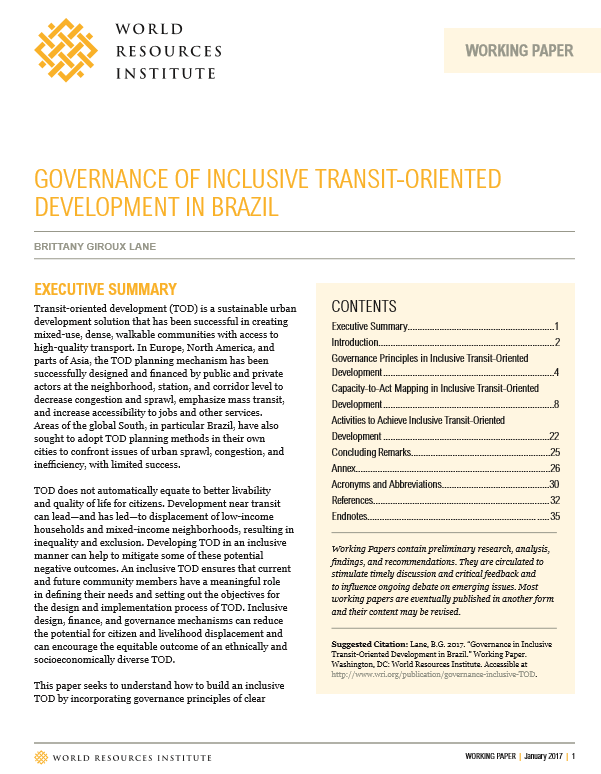
Governance of Inclusive Transit-Oriented Development in Brazil

31 DECEMBER 2016

Transit-oriented development (TOD)—a planning strategy focused on building compact, mixed-use neighborhoods with access to high-quality public transport and mobility options—is key to sustainable urbanization. However, TOD can be exclusive in its design and implementation, leading to the displacement of low-income residents and the gentrification of neighborhoods.


Developing more inclusive TOD processes can help urban communities mitigate potential negative outcomes. This working paper examines the role good governance principles of clear institutional arrangements, policy alignment, public participation, transparency and accountable can play in TOD. Using a new “capacity-to-act” mapping methodology to sketch out governance landscapes, the paper analyzes challenges to inclusive TOD in three Brazilian urban redevelopment case studies and identifies good practices that cities can adopt to avoid inequality and exclusion in TOD.

Related Content
View all

Mobility

TOD Implementation Resources and Tools

TOD concentrates mixed‑use development around transit, integrating land use, design, and infrastructure to create inclusive, resilient, walkable communities through coordinated city systems.
Knowledge Product

Learn more

Mobility

Transforming Cities with Transit: Transit and Land-Use Integration for Sustainable Urban Development

The study examines transit–land‑use integration, drawing global lessons and case studies to guide developing cities implementing BRT‑based transit‑oriented development.
Knowledge Product

Learn more

Mobility

Transit-Oriented Development Implementation Resources and Tools (Portuguese)

This toolkit guides cities in planning and implementing compact, transit‑focused development through adapted resources, practical tools, and integrated urban planning.
Knowledge Product

Learn more