

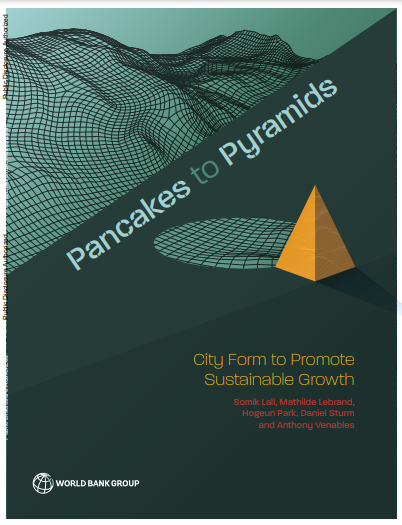
Towns and cities function as dynamic systems where interactions between people and firms shape urban form, economic performance, and growth patterns. Pancakes to Pyramids explores the drivers of urban spatial and economic development through the contrast between two models: “pancake” cities that expand outward with low density, and “pyramid” cities that combine outward growth with inward densification and vertical development.
The report highlights how transitioning toward more compact, dense urban forms can help cities better manage population growth and reduce greenhouse gas emissions. Drawing on new evidence, econometric analysis, and predictive modeling, it examines how past spatial evolution influences economic outcomes and identifies the conditions that enable cities to shift toward more sustainable, high-density development.