

Formulating an Urban Transport Policy: Choosing Between Options
01 NOVEMBER 2017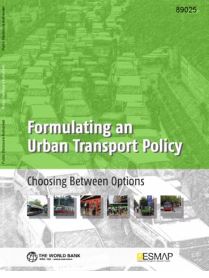
As the developing world rapidly urbanizes, the demands on transport systems also grow often at a faster pace than the population. Given the above tendency, an effective and coordinated approach to urban transport requires that sound policies be put into place. Such policies enunciate the direction that a government wants to take; they lay the basic framework for downstream planning as well as project identification and prioritization. This document policy lays out the guiding principles for more detailed downstream planning. The objective of this guideline is to improve mobility, environmental quality, universal access, safety, and energy security of any urban transport policy. This guidebook is intended to be a practical support for formulating urban transport policies at the national, provincial, and local levels. To this end, it highlights some of the important issues that arise when creating an urban transport policy.
The report is organized as follows: section one gives introduction. Section two presents a framework of possible actions, highlighting the avoid-shift-improve classification that has become common in professional practice. Section three talks about the governance of urban transport: which level of government should be responsible for it, which sector should lead it, and how different aspects should be coordinated. Section four highlights policies relating to land use planning and the benefits of integrating them with transport planning. Section five discusses the different modes of transport and whether there is a need for policies to promote any particular mode in preference to others. Section six delves into issues relating to personal motor vehicles and, more particularly, the extent to which policies should accommodate the car within the overall transport system. Sections seven and eight present policy options relating to public transport and para-transit, covering issues relating to pricing, coverage, technologies, etc. Section nine presents options relating to non-motorized modes. Section ten presents issues relating to parking, and section eleven suggests a balancing of supply-side measures and measures to contain demand. Section twelve highlights options relating to alternative fuels. Sections thirteen and fourteen cover the financing of urban transport and the role of the private sector. Finally, section fifteen covers issues relating to the process for formulating such policies, and options for implementation.