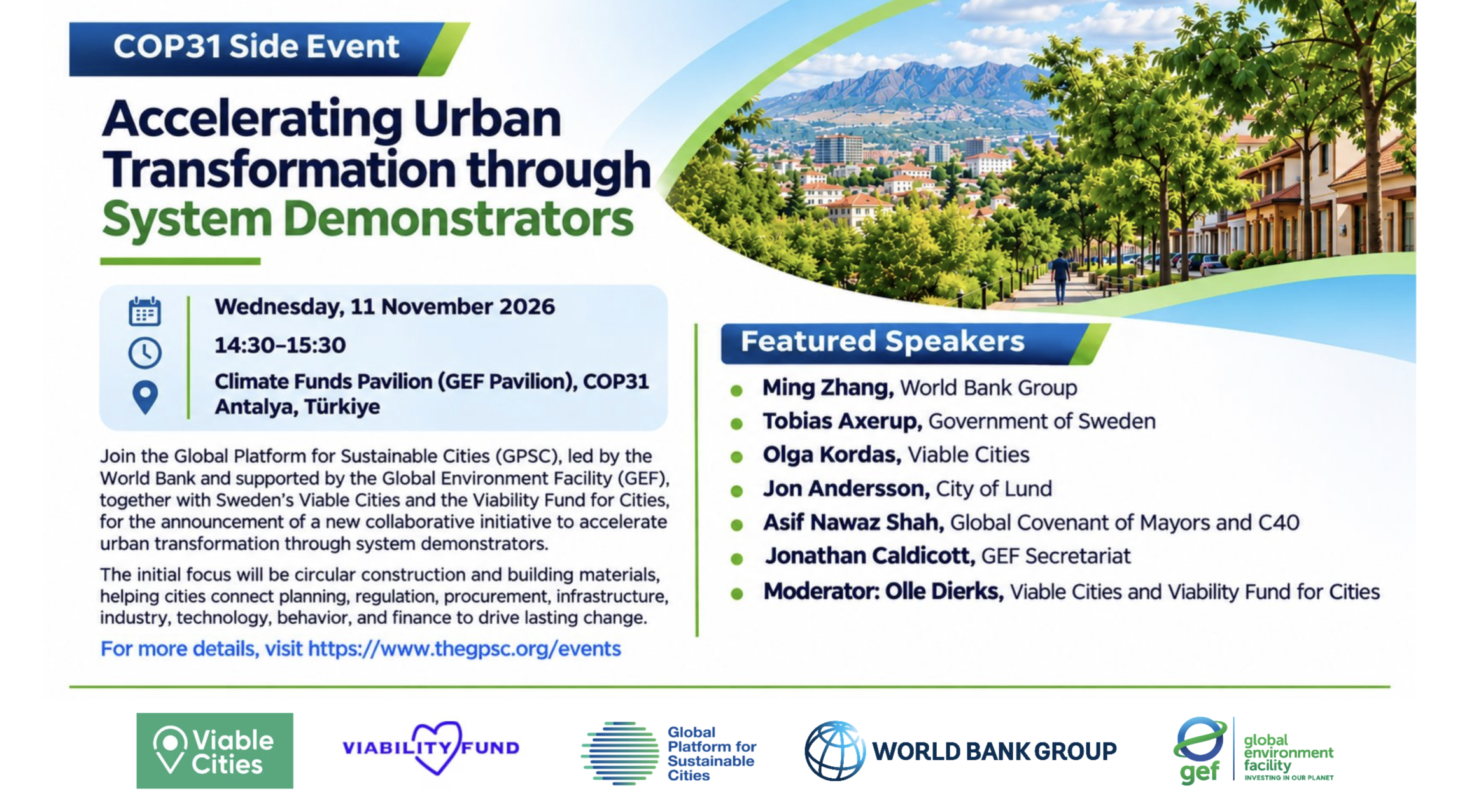


Accelerating Urban Transformation through System Demonstrators
Opening
The Global Platform for Sustainable Cities (GPSC), led by the World Bank and supported by the Global Environment Facility (GEF), together with Sweden’s Viable Cities and the Viability Fund for Cities, will host a joint event at COP31 to announce a new collaborative initiative aimed at accelerating urban transformation through system demonstrators.
The event will bring together representatives from the World Bank, GEF, the Swedish Government, and cities to explore how coordinated action across urban planning, regulation, investment, procurement, and industry can help cities advance climate action and environmental sustainability.
Advancing Urban Transformation through System Demonstrators
Cities play a critical role in driving climate action, yet urban transformation often involves fragmented projects, institutions, and financing mechanisms. System demonstrators offer an integrated approach that brings together public and private stakeholders, policies, technologies, and investments around shared objectives to achieve lasting change.
The proposed initiative will initially focus on circular construction and building materials, exploring how cities can reduce construction and demolition waste, promote material reuse and recycling, stimulate demand for low-carbon solutions, and unlock investment opportunities across the value chain.
The collaboration will begin with a limited number of city applications to develop and test a shared approach, generating practical lessons to inform future replication and sustainable urban development programs.
The event will take place on Wednesday, November 11, 2026, from 14:30 to 15:30, at the Climate Funds Pavilion (GEF Pavilion), COP31, Antalya, Türkiye. Download Flyer Here.
Time | Session | Speakers |
| 14:30–14:35 | Welcome and Framing |
|
| 14:35–14:55 | Announcement Panel: New Initiative on System Demonstrators for Circular Economy |
|
| 14:55–15:30 | Panel Discussion: Demonstrator Cities and Aggregated Demand Moderated by Olle Dierk |
|
System demonstrators are a methodology for urban systems change, developed by Viable Cities with other Swedish and international partners. They are designed to address complex urban challenges that require coordinated action between different actors and sectors.
Cities as systems
Cities are best understood as systems of interconnected systems. The way people move, how buildings are heated and cooled, where energy comes from, how land is used, and how materials and waste flow through a city are closely linked, to each other and to the regions, countries and global networks on which they depend. Changing such a system involves reconfiguring the relationships between technologies, infrastructure, regulation, business models and the roles and behavior of the actors involved. Too often, however, these areas are addressed through separate projects, institutions and funding streams, and promising individual projects do not add up to lasting systems change.
About system demonstrators
A system demonstrator is a portfolio of mutually reinforcing interventions in a defined place or urban system, bringing together the actors able to influence regulation, financing, business models, procurement, infrastructure and behavior. The system may be a district or neighborhood, a thematic domain such as mobility, energy or construction, or a combination of the two. System demonstrators were designed to connect these areas around a shared mission in a real place, focusing on how they combine to create a new system. From this perspective, cities are actors capable of driving demand and shaping markets as well as places where solutions are implemented.
Core to the methodology is an orchestration team, comprising the stakeholders that can make change happen and usually led by the local government. The team keeps the participating organizations engaged, captures learning through regular feedback, guards against mission drift, and builds the partnerships needed to sustain change. Each demonstrator needs a committed challenge owner, usually the local government, with the mandate, capacity and budget authority to act on the results.
Examples of system demonstrators in practice
CoAction Lund, Sweden. Orchestrated by Lund municipality, the demonstrator brings together 36 organizations to address energy and mobility challenges in a district with heavy commuter and freight traffic, high energy demand and limited grid capacity. Its system shift centers on EnergyNet, an architecture for local electricity networks with no need for conventional grid expansion.
Thriving Places, Bristol, United Kingdom. The demonstrator addresses affordable, zero-carbon housing on small brownfield sites that conventional development treats as unviable. The system shift is site aggregation: treating a cluster of small sites as a single program creates the scale needed to make building viable and provides a predictable volume of demand. The council has revised its finance strategy to allow appraisal at program level, 29 net-zero social rent homes are being delivered, and the approach has informed the UK Government's Small Sites Aggregator, rolled out nationally.
Green Routes, Bogotá, Colombia. The demonstrator addresses urban freight, with more than 67,000 trucks and vans on the city's streets each day. Because freight data sits inside individual providers, the city has been unable to plan logistics across the city as a whole. The system shift is a shared evidence base: a data governance and sharing agreement which gives the city real-time knowledge of how goods move through its streets and give logistics companies a basis for shared optimization.
The event will mark the beginning of a joint co-design process during 2027, through which the partners will further define the initiative, its initial city applications, and implementation arrangements. The collaboration aims to generate practical knowledge and scalable approaches that can inform future GEF Sustainable Cities programming.
1. System Demonstrators for Climate-Neutral Cities – Viable Cities: Introduces the system demonstrator methodology, explaining how coordinated interventions across sectors, institutions, and stakeholders can accelerate urban transformation. Includes information on the approach, its key components, and practical applications.
2. CoAction Lund – Viable Cities: Presents the CoAction Lund initiative in Sweden, illustrating how local authorities, businesses, and other stakeholders collaborate to address interconnected energy and mobility challenges through a system demonstrator.
3. System Demonstrators – Urban Transitions Lab: Explores the application of system demonstrators to complex urban challenges, presenting practical approaches and city examples, including initiatives in Lund and Bristol, to illustrate how coordinated interventions can support systemic change.